


OEM Stationery vs. Wholesale: 7 Key Differences to Know
OEM Stationery vs. Wholesale:
7 Key Differences Every Buyer Must Know
Whether you’re stocking a retail store, building a private-label brand, or sourcing corporate gifts — choosing between OEM stationery and wholesale can make or break your margins, timeline, and brand identity. This complete guide covers everything you need to decide.
OEM stationery vs. wholesale sourcing: why the choice matters more than you think
OEM stationery and wholesale sourcing are the two dominant models used by retailers, distributors, and brand owners to stock stationery products at scale. On the surface, both deliver products in bulk — but the differences in cost structure, brand ownership, flexibility, and long-term value are significant enough to determine whether your stationery business thrives or stagnates.
Many buyers default to one model without fully understanding the other. Some start with wholesale and never graduate to OEM, even when the economics clearly favor it. Others jump into OEM production before they have the volume or market data to justify the investment. Both are costly mistakes.
This guide is designed to give you complete clarity. By the end, you’ll understand exactly how OEM stationery and wholesale sourcing differ across seven critical dimensions, who each model is built for, and how to build a sourcing strategy that fits your business stage, budget, and brand goals.
ShinyYou Stationery is a Ningbo-based manufacturer with nearly 20 years of experience supporting both wholesale buyers and OEM clients across 50+ product categories. Trusted by Walmart, Disney, Dollar General, and 800+ global brands.
What is OEM stationery ?
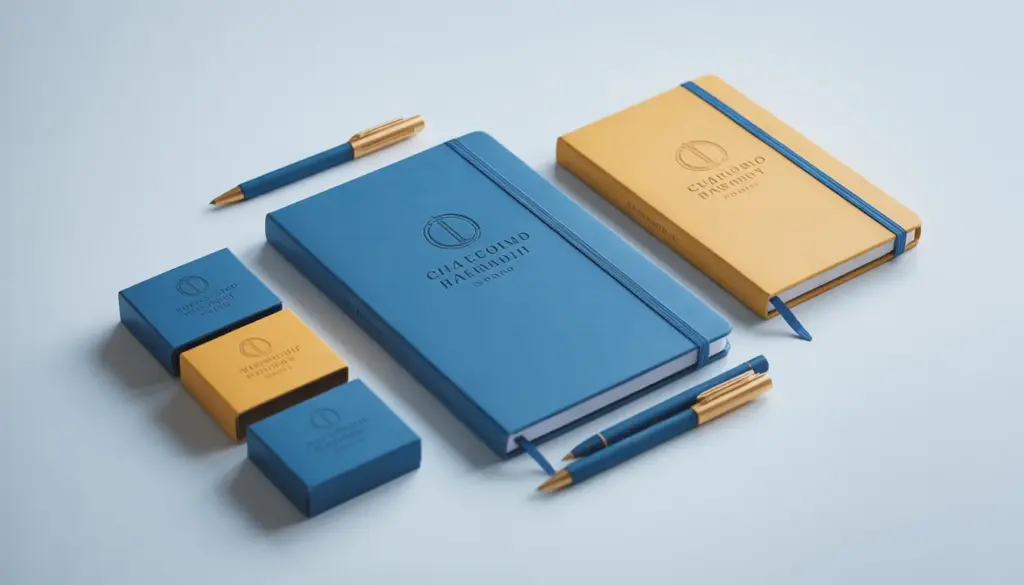
OEM stationery gives your brand full ownership of design, logo, packaging, and materials.
OEM stationery — short for Original Equipment Manufacturer stationery — refers to products that are custom-manufactured to your brand’s exact specifications. Under an OEM arrangement, you work directly with a factory or manufacturer to design and produce stationery items: notebooks, pens, pencil cases, desk organizers, stationery sets, and more — all bearing your brand identity.
With OEM stationery, you define the product. You specify the materials, dimensions, colors, logo placement, and packaging. The manufacturer produces it exclusively for you. No other retailer will be carrying the same item under your label.
OEM is the model used by some of the world’s biggest retailers. When you see a supermarket’s own-brand stationery line or a major retailer’s exclusive back-to-school collection, you’re almost certainly looking at OEM-manufactured products.
What OEM stationery typically involves:
- 🎨Custom product design — materials, shapes, colors, print, and finishes tailored to your brand
- 📦Custom packaging — branded boxes, polybags, hang tags, inserts, and labels
- 🔒Exclusive production — your product is not sold to other buyers
- 🧪Sample development and approval before mass production begins
- 🏭Quality control inspections at multiple stages of production
- 📋Compliance documentation tailored to your target market requirements
ShinyYou’s OEM stationery services cover everything from initial design consultation to sampling, mass production, QC inspection, and export logistics. Our 500m² showroom and in-house design team have supported private-label projects for global retailers including Disney and Walmart.
OEM stationery is not just for large corporations. At ShinyYou, we work with mid-size retailers, specialty chains, and growing e-commerce brands that have identified consistent bestsellers and are ready to build a proprietary product line.
What is Großhandelspapeterie sourcing?

ShinyYou’s wholesale stationery catalog covers 50+ categories with low MOQs and fast delivery.
Wholesale stationery sourcing means purchasing pre-manufactured, catalog-available products from a supplier in bulk quantities. The products already exist — designed, tested, packaged, and ready to ship. You browse the supplier’s range, select what you want, meet a minimum order quantity (MOQ), and receive your goods within a relatively short lead time.
Wholesale is the fastest, most accessible way to stock a stationery range. It’s low-friction, lower-risk, and gives buyers the flexibility to carry a wide variety of products without large upfront commitments to any single design.
What wholesale stationery typically involves:
- 🛒Ordering from a supplier’s existing catalog of ready-to-ship products
- 📉Lower minimum order quantities — ideal for small and medium retailers
- ⚡Short lead times — products can often ship within days to a few weeks
- 🔀Flexibility to mix and match products across categories
- 👀Products are also available to other retailers buying from the same supplier
- 🏷️Limited or no customization of the product itself
Wholesale stationery is the starting point for most new stationery retailers. It’s also the ongoing model for businesses that thrive on variety and seasonal refresh — sourcing new lines quickly and efficiently without long production cycles.
At ShinyYou, our wholesale catalog covers 50+ stationery categories — from writing instruments and paper supplies to bags, desk organizers, gifts, and party products. Our low MOQ structure is specifically designed to be accessible for small and medium buyers.
Quick comparison: OEM stationery vs. wholesale at a glance
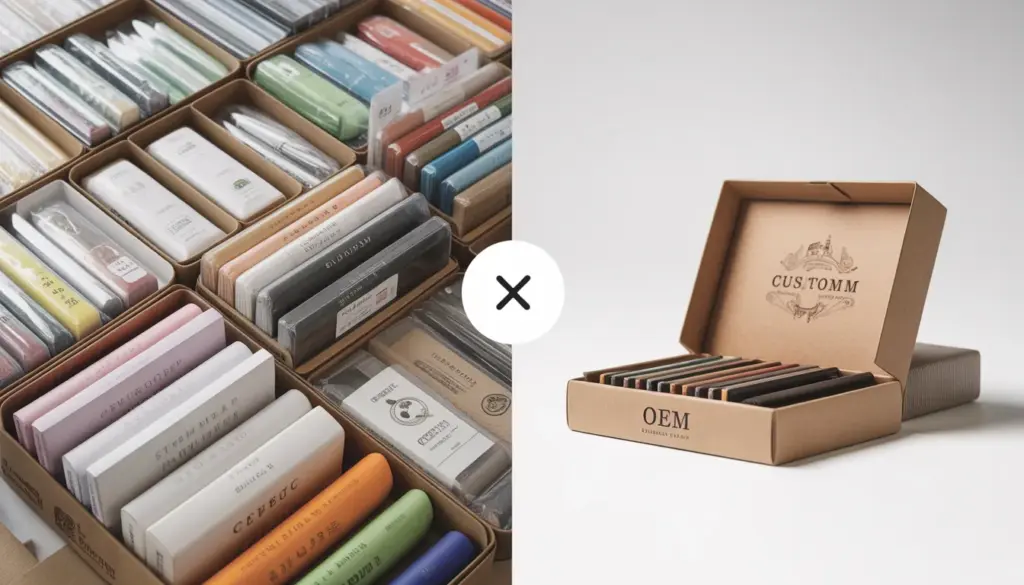
Wholesale offers speed and flexibility; OEM stationery delivers brand exclusivity and custom design.
Before diving into the detail, here’s a high-level overview of how the two models compare across the most important sourcing factors:
| Faktor | Wholesale | OEM Stationery |
|---|---|---|
| Personalisierung | Minimal — buy as-is | Full — logo, design, packaging, materials |
| Brand Exclusivity | Non-exclusive (shared catalog) | Fully exclusive to your brand |
| Minimum Order Qty | Low — flexible for small buyers | Higher MOQ per SKU |
| Lead Time | Days to a few weeks | 4–12 weeks (sampling + production) |
| Unit Cost at Scale | Fixed catalog pricing | Lower at higher volumes |
| Upfront Investment | Low — pay per order | Higher — sampling, tooling, MOQ |
| Produktpalette | Broad — mix and match categories | Specific — focused on your SKUs |
| Brand Identity Value | Low — no differentiation | High — own the product design |
| Best Stage | Testing, early-stage, seasonal fills | Scaling, established brands, volume buyers |
| Risk Level | Lower — buy what you need | Higher upfront, lower long-term |
7 key differences between OEM stationery and wholesale sourcing
Here’s a deep dive into the seven dimensions that separate these two sourcing models — and why each one matters for your bottom line and brand strategy.
OEM stationery gives you complete control over what you sell. You define the product from the ground up — materials, dimensions, color palette, logo placement, finish, and packaging. The result is a product that belongs to your brand and cannot be replicated by a competitor buying from the same supplier.
Wholesale gives you access to quality, pre-designed products quickly, but you’re selling what dozens or hundreds of other retailers are also selling. There’s no proprietary product advantage.
In competitive retail markets — whether physical or online — differentiation matters enormously. OEM stationery products are yours exclusively. When customers see your branded notebook or pencil case on a shelf or in an Amazon listing, they’re looking at something that only you carry.
Wholesale products, by contrast, can be found across multiple retailers simultaneously. This drives price competition and makes it harder to build lasting brand loyalty based on your product range. Customers may find the same product cheaper elsewhere.
Wholesale sourcing is accessible at relatively low order quantities. You can often order small quantities across many SKUs, making it easy to maintain a wide and varied product range without overcommitting capital to any single item.
OEM stationery orders require higher minimum quantities per SKU. This is because custom production involves setup costs — tooling, mold creation, design work, and sample development — that need to be amortized across a sufficient number of units to be economically viable. The higher the MOQ, the lower the per-unit cost becomes.
If you need to respond quickly to a market opportunity — a seasonal trend, a competitor gap, or a last-minute promotional window — wholesale wins decisively on speed. Orders placed with an established wholesale supplier like ShinyYou can often ship within days to a few weeks.
OEM stationery production requires time. The process includes briefing, design development, sampling, client review and revisions, approval, mass production, QC inspection, and logistics. A realistic OEM timeline runs from 4 to 12 weeks, sometimes longer for complex or high-volume projects. Planning ahead is not optional — it’s essential.
Wholesale pricing is straightforward — you pay the catalog price, which already factors in the supplier’s design, production, and margin. As you order more, you may access volume discounts, but the base unit cost structure is fixed.
OEM stationery becomes significantly more cost-efficient at scale. Because you’re paying for direct production without intermediary margin layers, and because the fixed setup costs are spread across a larger number of units, the per-unit cost of OEM products drops considerably compared to equivalent wholesale catalog items at high volumes. For brands with consistent, predictable demand, this margin advantage is substantial.
Wholesale is the lower-risk model from a cash flow perspective. You order what you need, when you need it. There are no design development fees, no tooling costs, and no large committed production runs before you’ve validated demand.
OEM stationery requires meaningful upfront investment before a single product ships. Sampling, tooling, design, and the larger minimum production run all require capital commitment. The financial risk is higher — but so is the potential return, especially once you have sales data confirming demand for the product you’re commissioning.
Both models can deliver high-quality products — but the control mechanisms differ. With wholesale, quality is defined by the supplier’s catalog standards, which are fixed. What you see in a sample is what you receive in production, without variation.
With OEM stationery, you define the quality standards — and you have the ability to set specs that meet or exceed your own customers’ expectations. This includes material grades, tolerances, finishing details, and compliance certifications relevant to your target market. The tradeoff is that quality management requires more active involvement during the development phase. Choosing a manufacturer with strong QC infrastructure — like ShinyYou’s certified audit process — is critical.
Which sourcing model is right for your business?
There’s no universal answer — the right model depends on where your business is today and where you want it to go. Use the framework below to guide your decision.
✅ Choose Wholesale If You…
- Are launching or testing a new product category for the first time
- Need inventory quickly for an upcoming season, campaign, or event
- Have limited capital and need flexible, low-commitment order sizes
- Run a boutique, gift shop, variety store, or multi-category online store
- Want to carry a broad, refreshable range without managing production
- Are not yet ready to commit to a single product identity or brand line
✅ Choose OEM Stationery If You…
- Have proven bestsellers with consistent, high-volume demand
- Want to build a recognizable private-label brand identity
- Source for corporate gifting, branded promotional stationery, or B2B contracts
- Are an importer or distributor supplying large retail chains
- Need products that meet specific compliance requirements for your market
- Are ready to invest in brand differentiation for long-term margin advantage
A useful rule of thumb: if a product category is generating consistent monthly reorders at meaningful volume, it’s a strong candidate for transitioning to OEM stationery. The investment pays back quickly when the unit cost savings are applied across the full annual sales volume of a proven SKU.
The hybrid strategy: using OEM stationery and wholesale together
The most successful stationery businesses don’t choose between OEM stationery and wholesale — they use both models strategically in parallel. This hybrid approach maximizes the strengths of each while mitigating their individual weaknesses.
Here’s how the hybrid sourcing cycle typically works in practice:
Source a broad selection of products from ShinyYou’s wholesale catalog across multiple categories. Use low MOQs to stock your initial range without overcommitting. This phase is about learning — which products sell, which price points work, and what your customers respond to.
After 1–2 buying cycles, you’ll have clear data on which SKUs generate steady, predictable reorders. These are your candidates for OEM stationery production. The goal is to identify 3–5 products that form the backbone of your sales volume.
Commission custom OEM production of your proven bestsellers under your brand name. At this stage, the financial risk is dramatically reduced because you have sales data validating demand. You’re not guessing — you’re scaling what already works.
Keep using wholesale sourcing to trial new product categories, respond to seasonal trends, and fill gaps in your range. Wholesale remains your low-risk exploration tool, while OEM becomes your brand-building engine for proven products.
Over time, your OEM stationery portfolio expands as more wholesale products prove their demand. Your brand identity strengthens, your margins improve, and your competitive differentiation deepens. ShinyYou supports this entire journey from a single supplier relationship.
The beauty of this approach is that it de-risks the OEM investment entirely. You’re only commissioning custom production for products that have already demonstrated market demand. And because ShinyYou supports both models under one roof, you never need to manage separate supplier relationships for wholesale and OEM products.
Common OEM stationery sourcing mistakes to avoid
Whether you’re exploring OEM stationery for the first time or reviewing your wholesale strategy, these are the most common and costly errors buyers make — and how to avoid them.
Mistake 1: Jumping into OEM before validating demand
Commissioning custom OEM stationery production for an untested product category is one of the most expensive mistakes a buyer can make. If the product doesn’t sell, you’re left with a large quantity of branded, unsellable inventory with no resale path. Always use wholesale sourcing to validate demand before committing to OEM production on a new category.
Mistake 2: Underestimating OEM lead times
Many first-time OEM buyers are caught off-guard by the development timeline. Failing to account for sampling rounds, revision cycles, production scheduling, quality inspection, and export logistics can leave you with empty shelves during peak selling periods. Work backwards from your in-store date and build in at least 12–14 weeks for the first OEM run of a new product.
Mistake 3: Choosing a wholesale-only supplier for OEM production
Not all wholesale suppliers have genuine OEM manufacturing capability. Some brokers present themselves as manufacturers but outsource production to third parties, adding cost, reducing quality control, and introducing supply chain risk. For reliable OEM stationery production, work directly with a vertically integrated manufacturer — one with in-house production, design capability, and QC infrastructure. ShinyYou operates its own factory and design team in Ningbo, China, giving clients direct manufacturer access without intermediary layers.
Mistake 4: Ignoring compliance requirements for your target market
Different markets have different compliance standards — REACH in Europe, CPSC in the USA, AS/NZS in Australia, and others. Custom OEM stationery products must meet the specific compliance requirements of the market they’ll be sold in. Failing to address this during product development, rather than after production is complete, is extremely costly. ShinyYou’s certified audit process includes compliance documentation support for major international markets.
Mistake 5: Not specifying packaging in enough detail
For branded OEM stationery, the packaging is as important as the product itself. Many buyers focus heavily on the product specification and give insufficient attention to the packaging brief. Vague packaging instructions lead to revisions, delays, and sometimes expensive reprints. Provide your OEM manufacturer with complete packaging specs — dimensions, print files, barcode requirements, inner carton configuration, and retail display expectations — from the start.
The most effective way to avoid all five mistakes is to work with a manufacturer that has a structured OEM development process — one that guides you through briefing, sampling, approval, and compliance before committing to mass production. That’s exactly the process ShinyYou follows with every OEM client.
Why choose ShinyYou for OEM stationery and wholesale?
ShinyYou Stationery is a Ningbo-based manufacturer and wholesale supplier with nearly 20 years of experience serving global retailers, importers, and brand owners. We are one of the few suppliers in the stationery industry that fully supports both wholesale and OEM stationery sourcing under one roof — making us the ideal long-term partner as your business grows from product testing to brand building.
Own-factory production in Ningbo with direct QC — no middlemen, no outsourcing risk.
In-house design team supporting custom product development from brief to bulk production.
Comprehensive wholesale catalog covering writing instruments, paper, bags, organizers, gifts, and more.
Sustainable materials and FSC-certified options available across our Umweltverträgliche Kollektion.
OEM stationery supplier for Walmart, Disney, Dollar General, and 800+ brands worldwide.
Audited factory with certifications covering major international retail compliance requirements.
Continuously refreshed wholesale catalog keeping your range trend-aligned and competitive.
Sales and support teams serving buyers in English, Arabic, French, German, Spanish, and more.
Explore our product collections
Frequently asked questions about OEM stationery
Here are the questions our wholesale and OEM stationery buyers ask most frequently.
What exactly does “OEM stationery” mean?
OEM stands for Original Equipment Manufacturer. In the context of stationery, OEM stationery refers to products that are custom-manufactured to a buyer’s specific brand requirements — including custom logos, colors, packaging, and product specifications. The products are produced exclusively for that buyer’s brand. OEM stationery is distinct from wholesale, where buyers purchase from a shared, pre-designed product catalog.
What is the minimum order quantity for OEM stationery at ShinyYou?
Minimum order quantities for OEM stationery vary depending on the product category, the complexity of the customization, and the production process involved. Generally, OEM orders require higher MOQs than wholesale catalog orders to cover setup and tooling costs. Contact our team at VIP1@shinyyoustationery.com for a tailored MOQ and pricing quote for your specific product requirements.
How long does OEM stationery production take from brief to delivery?
A typical OEM stationery production timeline at ShinyYou runs from 4 to 12 weeks from initial brief to delivery, depending on the product complexity, the number of sampling rounds required, and the production volume. This includes: design consultation (1–2 weeks), sample development (2–4 weeks), client approval and revisions (1–2 weeks), mass production (3–5 weeks), QC inspection (concurrent), and export logistics (1–3 weeks). We recommend planning at least 14 weeks for your first OEM run to allow buffer for revisions.
Can I order both wholesale and OEM stationery from ShinyYou?
Yes — and this is actually the most common arrangement for growing stationery businesses. ShinyYou fully supports hybrid sourcing, where clients place wholesale orders from our catalog alongside OEM stationery development projects. Many clients begin with wholesale orders and gradually shift their proven bestsellers into OEM production as their volumes grow. Having a single supplier for both models simplifies your supply chain significantly.
Does ShinyYou offer eco-friendly options for OEM stationery?
Yes. ShinyYou offers eco-friendly materials, FSC-certified paper products, and sustainable packaging options across both our wholesale catalog and OEM production. Our Umweltverträgliche Kollektion showcases a range of wholesale products using sustainable materials. For OEM stationery, we can incorporate eco-certified materials into custom product briefs. We also operate under sustainability practices that comply with major international retailer standards.
How does ShinyYou handle quality control for OEM stationery?
ShinyYou’s quality control process for OEM stationery includes multiple checkpoints: pre-production material inspection, in-process quality checks during production, and a final pre-shipment inspection before goods are released. Our factory operates under certified audit standards, and we provide compliance documentation relevant to your target market. Clients receive photo and video documentation of QC inspections as standard, with third-party inspection support available on request.
What stationery products are most popular for OEM custom manufacturing?
The most popular OEM stationery categories at ShinyYou include notebooks and journals (hardcover, spiral, softcover), pencil cases and pouches, pen and gel pen sets, desk organizers and stationery sets, school backpacks and bags, and branded gifting collections. Products with strong gifting appeal, seasonal demand, or high brand visibility tend to deliver the strongest ROI when produced as OEM stationery versus purchased wholesale.
What is the difference between OEM and ODM stationery?
OEM (Original Equipment Manufacturer) stationery is produced to the buyer’s own design specifications — the buyer owns the product design and the manufacturer builds it. ODM (Original Design Manufacturer) stationery is produced using the manufacturer’s existing designs, which the buyer can brand but does not own. ShinyYou offers both: OEM stationery for clients with their own product concepts, and ODM-style customization for clients who want to brand existing ShinyYou designs from our catalog.
Related guides from ShinyYou Stationery
Continue exploring our wholesale and sourcing resources:
Ready to source OEM stationery or place a wholesale order?
Contact the ShinyYou team for a free consultation, catalog access, and a tailored quote for your business needs.