

Private Label Manufacturer: 10-Step Stationery Process from Sample to Production
From brief to finished product — the complete private label manufacturer process for stationery brands.
Working with a private label manufacturer for the first time? The process is more straightforward than most buyers expect — if you know each step before you start.
Whether you are launching a stationery brand, expanding a gift shop, or building a corporate merchandise line, understanding how a private label manufacturer takes your idea from concept to finished product is essential. Get it right and you build a line that looks and sells like a proprietary brand. Get it wrong and you pay for mistakes in wasted samples, delayed shipments, and production runs that do not match your vision.
This guide walks you through all 10 steps — from your first inquiry to your finished branded stationery arriving ready to sell.
Table of Contents
- What Is Private Label Stationery?
- Step 1 — Define Your Product Vision
- Step 2 — Find the Right Private Label Manufacturer
- Step 3 — Submit Your Brief and Design Files
- Step 4 — The Sample Phase
- Step 5 — Review and Approve Your Sample
- Step 6 — Confirm Production Quantities and Lead Times
- Step 7 — Quality Control During Production
- Step 8 — Packaging and Branding Details
- Step 9 — Shipping and Import Considerations
- Step 10 — Build a Long-Term Manufacturer Relationship
- Common Private Label Mistakes to Avoid
- Start Your Private Label Stationery Order Today
1. What Is Private Label Stationery?
Private label stationery refers to products manufactured by a third-party supplier but sold under your own brand name, logo, and packaging.
Instead of building manufacturing infrastructure from scratch, you partner with a private label manufacturer who already has the equipment, materials, and expertise — and you supply the brand identity.
The result: notebooks, journals, planners, pens, notepads, greeting cards, and desk accessories that look and feel like your own proprietary line, without the overhead of running a factory.
This model is used by independent stationery brands, gift retailers, corporate procurement teams, and online stores worldwide. It is one of the most capital-efficient paths to a branded product line — when you understand the process from end to end.
2. Step 1 — Define Your Product Vision Before You Contact Any Private Label Manufacturer
Before you contact a single private label manufacturer, get specific about what you want to produce.
The more detail you bring to the first conversation, the faster your sampling process moves — and the fewer revision rounds you pay for.
Key decisions to lock in at this stage:
Product type. Are you producing hardcover journals, spiral-bound planners, memo pads, pen sets, sticky note collections, or desk accessories? Each involves different production methods and minimum order quantities.
Materials and specifications. Cover material (linen, PU leather, kraft, fabric), paper weight and ruling (blank, lined, dotted, grid), binding type (sewn, glued, spiral, disc), and dimensions all affect cost and lead time.
Target quantity. Most private label manufacturers set minimum order quantities (MOQs). Knowing your budget range early helps you qualify manufacturers quickly.
Branding requirements. Logo placement, embossing, foil stamping, custom printing, packaging inserts, and label needs should all be mapped out before sampling begins.
3. Step 2 — Find the Right Private Label Manufacturer for Stationery
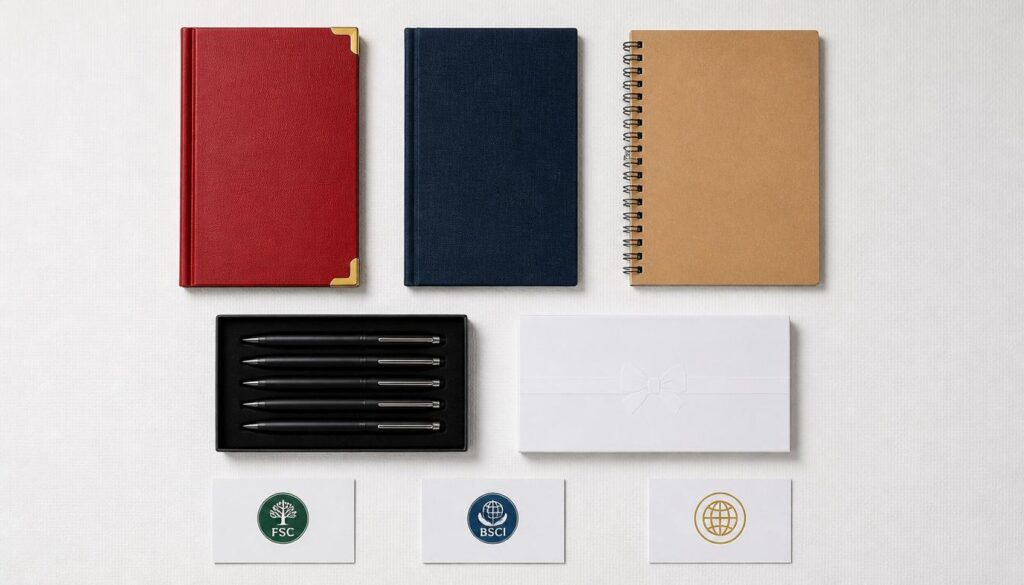
Choosing the right private label manufacturer means verifying certifications, in-house capabilities, and sample quality before committing to production.
Not all manufacturers are the same — and choosing the wrong one is the most expensive mistake in private label stationery.
A private label manufacturer specializing in stationery understands paper grain, binding tension, foil behavior on textured covers, and ghosting under fine-liner ink. A generic print shop does not.
When evaluating a private label manufacturer, look for:
Stationery-specific experience. Ask for their product catalog and client references. Experience with notebooks, planners, and desk accessories signals the right production environment.
In-house capabilities. The best private label manufacturers handle printing, binding, and packaging under one roof. Outsourcing steps to third parties adds time and risk.
Sample policy. Reputable manufacturers offer pre-production samples before mass production begins. Be cautious of any supplier who resists this.
Communication quality. Stationery projects involve close design feedback loops. A manufacturer with responsive, English-speaking project managers saves significant time.
Certifications. If you are selling in the EU or US retail market, check for FSC certification (sustainable paper sourcing), REACH compliance, BSCI audit, and relevant child safety certifications. According to FSC International, demand for certified sustainable paper products continues to grow — particularly in back-to-school and corporate procurement channels.
4. Step 3 — Submit Your Brief and Design Files to the Private Label Manufacturer
Once you have selected your private label manufacturer, the process begins with a formal product brief.
This document becomes the reference point for your entire order. A strong product brief includes:
- Product dimensions (height × width × spine width)
- Number of pages and paper weight (e.g., 80gsm or 100gsm)
- Cover material, color, and finish (matte, gloss, soft-touch laminate)
- Binding method
- Interior layout (ruling style, page numbering, section dividers)
- Logo files in vector format (AI, EPS, or high-resolution PDF)
- Pantone color references for brand consistency
- Packaging requirements (polybag, box set, belly band, retail hang tag)
Your manufacturer will review the brief and return a formal quote with a production specification sheet. Review this carefully — discrepancies here cause expensive errors in production.
5. Step 4 — The Sample Phase with Your Private Label Manufacturer
This is the most important and most underestimated phase. Skipping or rushing samples is the number one cause of costly production mistakes in private label stationery.
Pre-Production Samples (PPS)
A professional private label manufacturer will produce a physical pre-production sample — a single unit or small run built to your exact specifications — before any mass production begins.
This sample lets you verify:
- Cover feel, weight, and finish
- Print registration and color accuracy
- Binding tightness and lay-flat quality
- Paper ghosting or bleed-through under pen and marker
- Embossing depth and foil clarity
- Packaging fit and presentation
Feedback Rounds
Expect one to two rounds of sample revisions. This is normal. Common adjustments include cover color shifts (printing on textured materials behaves differently than on screen), minor dimension tweaks, and paper swaps if ghosting is an issue.
Pro tip: Test the sample with the actual pens or markers your customers will use. A notebook that looks perfect but bleeds through with a fine-liner is a product returns problem waiting to happen.
6. Step 5 — Review and Approve Your Sample
Before production begins, your private label manufacturer will ask for a formal written sample approval.
This sign-off confirms that the mass production run should match the approved sample exactly. Keep your approved sample in a safe place — it becomes your quality benchmark for the entire order.
Do not rush this step. Common things buyers miss on sample review:
- Spine width accuracy (affects cover wrap on thicker notebooks)
- Foil color match under natural light vs. artificial light
- Packaging insert fit — does the product sit correctly inside?
- Barcode placement and scan readability
- Page count accuracy against the brief
If something is off, call it now. It costs a fraction of the price to fix at the sample stage compared to a full production run.
7. Step 6 — Confirm Production Quantities and Lead Times with Your Private Label Manufacturer
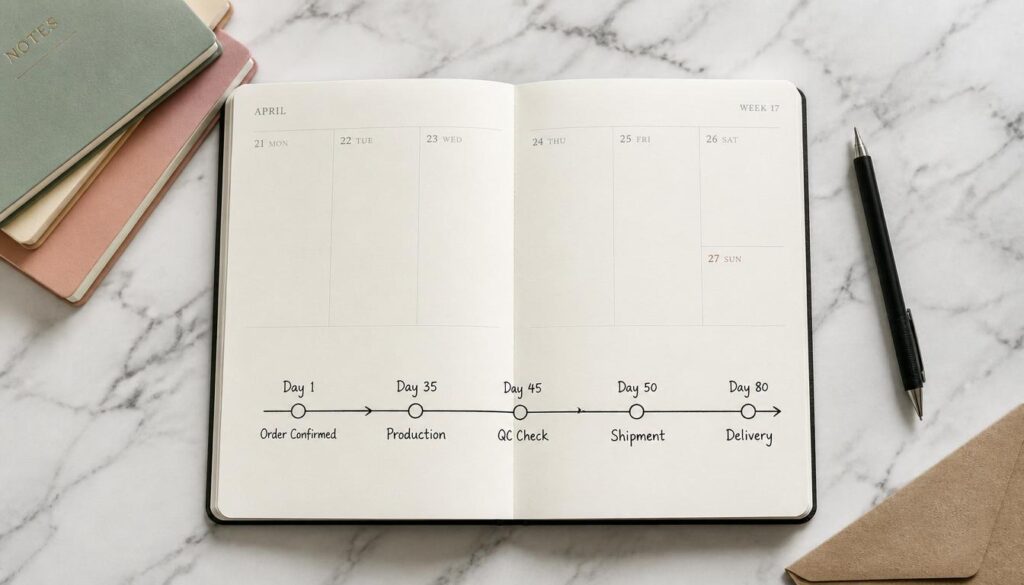
Total lead time equals production plus freight — the calculation every private label stationery buyer must plan around.
Once your sample is approved, confirm the full production schedule in writing before releasing your deposit.
MOQs (Minimum Order Quantities). For stationery, MOQs typically range from 300 to 1,000 units per SKU depending on complexity. Embossed covers, foil finishes, and custom inserts usually push MOQs higher because setup costs are spread across more units.
Production lead time. Standard lead times run 30 to 60 days from sample approval, depending on order size and the manufacturer’s current production queue.
Shipping time. If you are sourcing internationally — China, India, and Southeast Asia are common private label manufacturing hubs — add freight time separately. Sea freight from China to Europe or North America typically adds 20 to 35 days.
Total timeline = production lead time + freight lead time. Buyers who calculate only production time consistently receive orders two to four weeks later than expected.
Rush orders. Some private label manufacturers offer expedited production at a 15 to 30% premium. Plan your timelines early to avoid this cost.
8. Step 7 — Quality Control During Production
Professional buyers do not just trust — they verify. Quality control is your insurance policy against receiving thousands of units that do not match your approved sample.
In-Line QC
Ask your manufacturer what in-line checks they perform during production. This should include print checks after the first run, binding tension testing, and periodic sampling from the production line.
Pre-Shipment Inspection
A pre-shipment inspection (PSI) is a third-party audit conducted when production is 80 to 100% complete. Inspection companies send an agent to the factory floor to check a random sample against your approved specifications — verifying dimensions, print quality, packaging, and carton labeling.
If the inspection reveals defects above your Acceptable Quality Level (AQL), you have grounds to hold the shipment and require rework before payment and dispatch.
This step is particularly important when working with a private label manufacturer for the first time. It protects your investment and establishes clear quality standards for future orders.
9. Step 8 — Packaging and Branding Details
Private label stationery lives or dies on its unboxing presentation. Your manufacturer should handle all packaging elements as part of the production run.
Belly bands and sticker labels. A cost-effective way to brand neutral product without custom-printing every component.
Custom gift boxes and rigid packaging. For premium journals and gift sets, a sturdy box with branded tissue paper or ribbon adds significant perceived value.
Hang tags and care cards. If you are selling through retail, swing tags with barcodes, pricing, and brand messaging are essential.
Polybag with label. For online and wholesale, a sealed polybag with a printed label keeps products clean and clearly identified by SKU.
Discuss packaging requirements during the briefing stage — not after production. Retrofitting packaging after the fact adds delays and cost.
10. Step 9 — Shipping and Import Considerations
When your order clears QC, it is time to ship. For international orders, you will need to choose your freight method and understand your import obligations.
Sea freight (FCL or LCL). Full container load or less-than-container load are the most economical options for large orders. Transit times from Asia to North America or Europe run 20 to 40 days.
Air freight. Faster (5 to 10 days) but significantly more expensive per kg. Suitable for small orders, samples, or urgent restocks.
Incoterms. Agree on shipping terms with your manufacturer. FOB (Free on Board) is the most common arrangement — the private label manufacturer covers costs to the port; you cover freight, insurance, and import duties from there.
Import duties and HS codes. Stationery and notebooks fall under specific Harmonized System (HS) codes that determine duty rates. Consult a licensed customs broker if you are importing for the first time. You can verify commodity codes through US Customs and Border Protection or your local customs authority.
11. Step 10 — Build a Long-Term Private Label Manufacturer Relationship
The best private label manufacturers are not just vendors — they become strategic production partners.
Forecast ahead. Share your sales projections so your manufacturer can plan material sourcing and production slots for you.
Provide consistent feedback. Constructive feedback after each run helps them improve quality over time and signals that you are a serious long-term buyer.
Consolidate SKUs where possible. Ordering multiple products in the same production run reduces setup costs and often qualifies you for better unit pricing.
Pay on time. Manufacturers prioritize reliable buyers. Consistent payment builds goodwill that translates to better lead times and priority scheduling during busy seasons.
12. Common Private Label Manufacturer Mistakes to Avoid
The most expensive private label mistakes are almost always planning failures — not product failures.
Skipping the sample phase to save time. A sample costs a fraction of a production run and prevents defective inventory. This shortcut is always the most expensive one.
Choosing a supplier on price alone. The lowest quote often means shortcuts in materials, print quality, or QC. Evaluate the full picture — certifications, communication, sample quality, and references.
Underestimating total lead time. Factor in sample revisions, production, shipping, and customs clearance from day one. Most first-time buyers underestimate total timelines by 30 to 50%.
Not having design files ready. Waiting until after you have chosen a private label manufacturer to finalize your logo files wastes everyone’s time and delays your launch.
Ignoring packaging until the last minute. Packaging is part of production, not an afterthought. It affects costs, timelines, and the customer experience.
13. Start Your Private Label Stationery Order with Shiny You Today
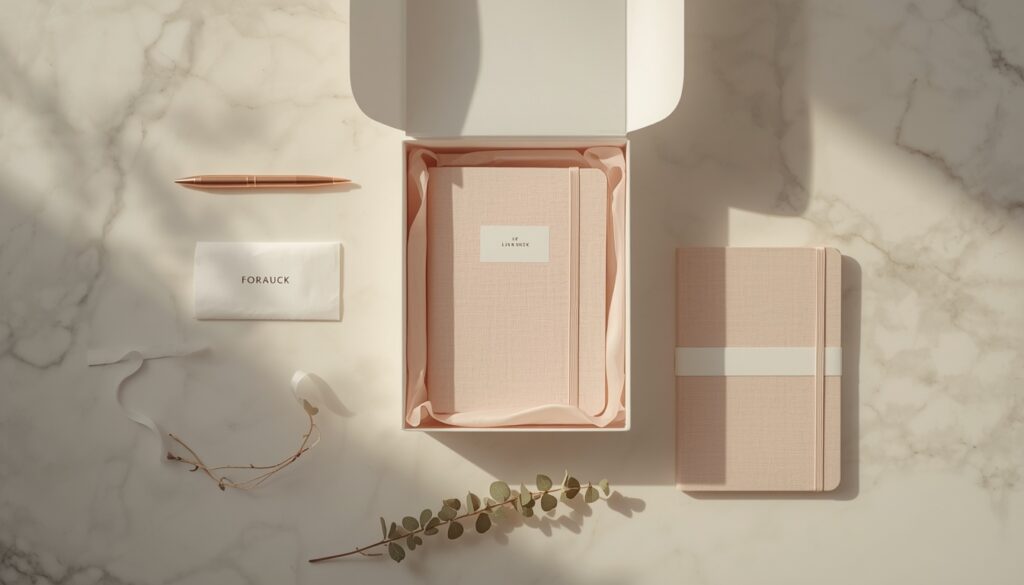
Ready to launch your stationery brand? Shiny You handles every step — from sample to production to your door.
Shiny You Stationery is a professional private label manufacturer based in Ningbo, China — with nearly 20 years of experience supporting stationery brands across 30+ countries.
We handle every step of the process covered in this guide — from initial brief and sample production to quality control, packaging, and shipment.
Here is what we offer for your private label stationery order:
- Full OEM and private label manufacturing — notebooks, journals, planners, pens, desk accessories, gift sets
- Low MOQs — entry from 300 units per SKU
- In-house sample production — physical pre-production samples before any mass run
- Full certification portfolio — BSCI, FSC, EUDR, FDA, Walmart FCCA, SCAN, Disney
- Complete packaging solutions — belly bands, rigid boxes, hang tags, polybag, custom inserts
- Quote within 24 hours — send your product brief and we respond the same business day
Browse our full stationery range or contact our team to start your private label project today.
The right private label manufacturer makes the difference between a brand that launches cleanly and one that burns cash fixing avoidable problems. Get in touch and let’s build your stationery line the right way.