

Stationery Packaging: Custom Options for Wholesale Buyers
Custom Stationery Packaging: What Options Are
Available for Wholesale Buyers in 2026
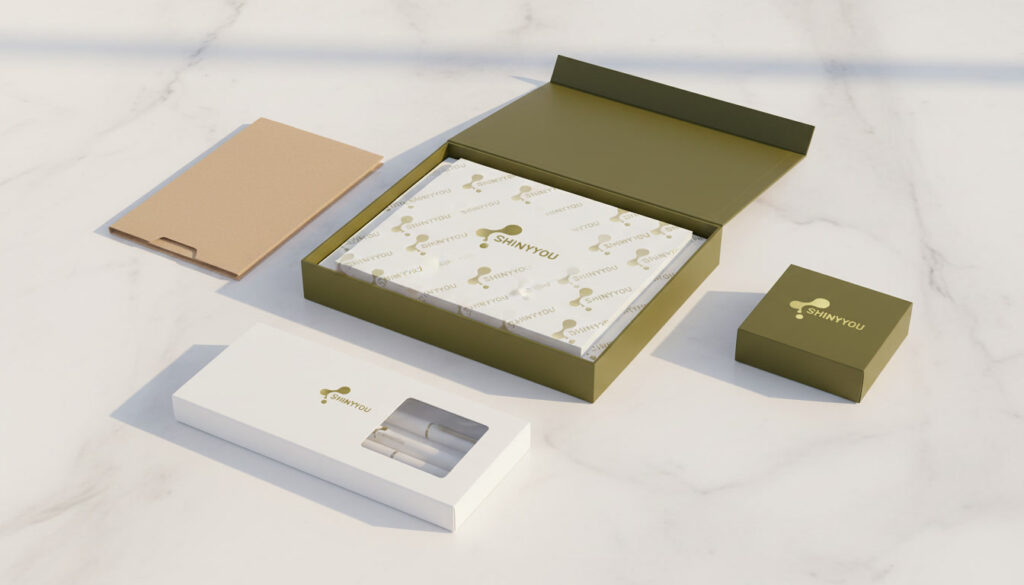
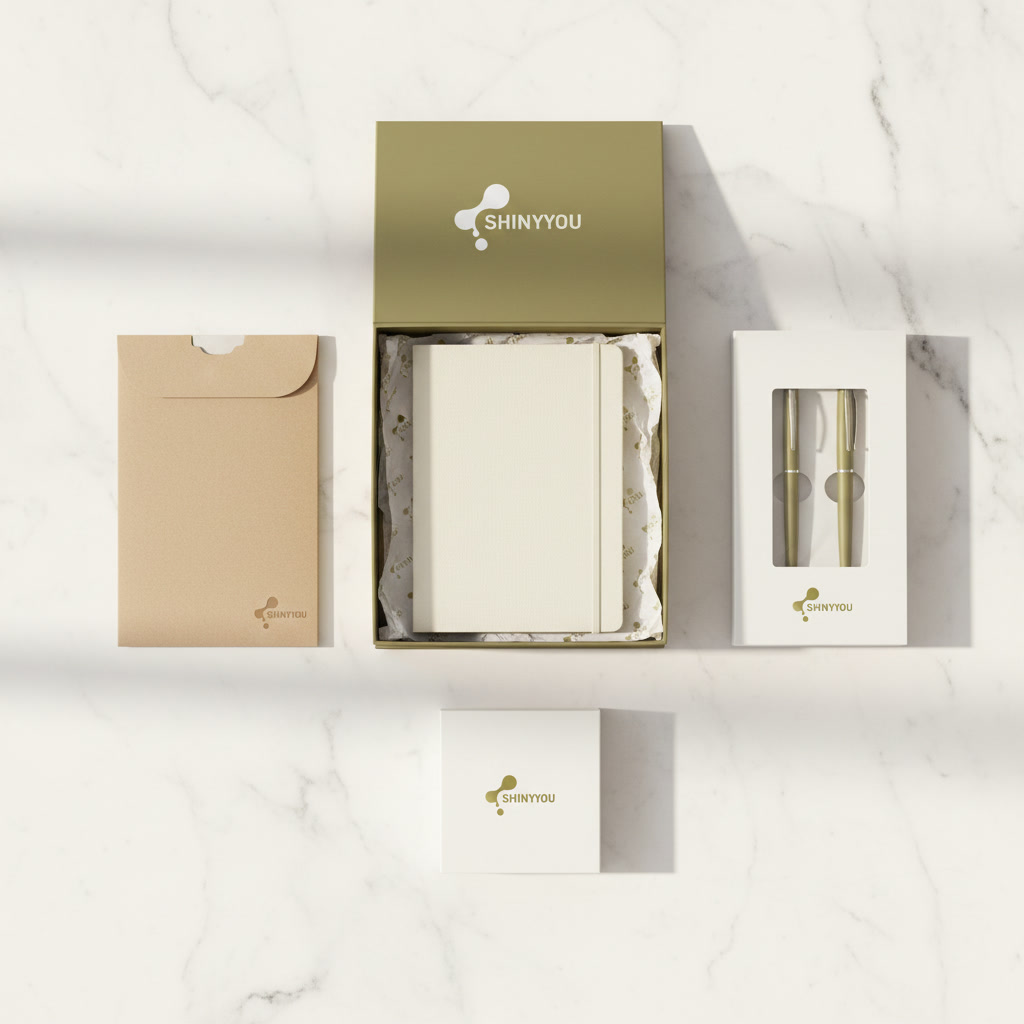
Four formats. One purpose — packaging that sells the product before it’s even opened.
Good stationery packaging does more than protect a product — it sells it before the customer has even opened the box. For wholesale buyers, retailers, and corporate gifting programmes, the packaging decision is as commercially important as the product inside it. The right stationery packaging communicates brand quality, justifies premium pricing, and creates the kind of unboxing experience that turns one-time buyers into repeat customers.
This guide covers every major custom stationery packaging wholesale option available in 2026 — materials, structures, finishes, and how to choose the right format for your products, your market, and your budget.
Table of Contents
- Why Stationery Packaging Matters More Than Ever
- Packaging Materials — What’s Available
- Box Structures — Choosing the Right Format
- Finishing Options — From Matte to Foil
- Branded Stationery Boxes for Different Product Types
- Eco-Friendly Stationery Packaging Options
- Packaging for Corporate Gifting
- Packaging for Retail Display
- MOQ and Lead Times for Custom Packaging
- How to Brief a Packaging Design Project
- Order Custom Stationery Packaging with Shiny You
1. Why Stationery Packaging Matters More Than Ever
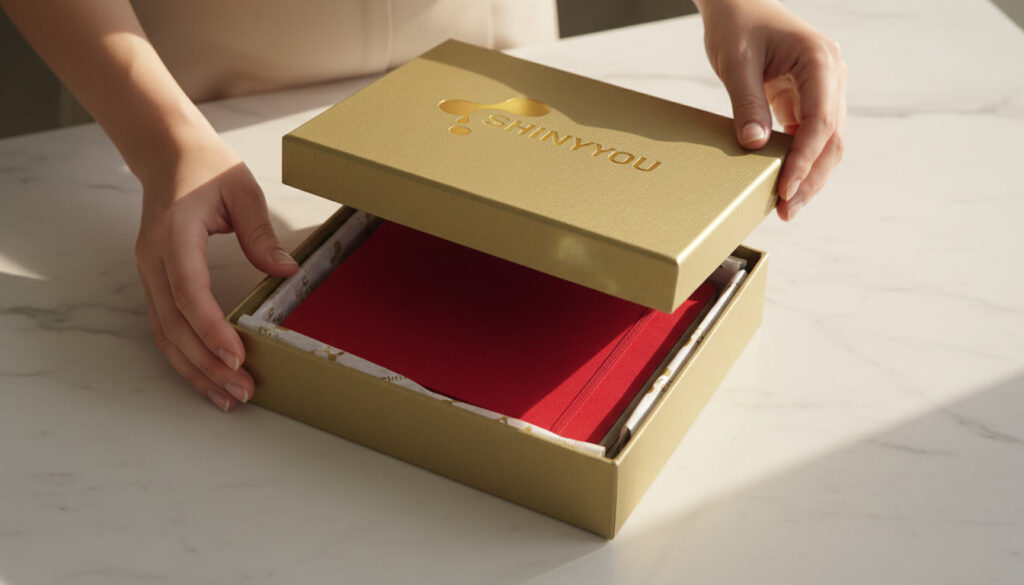
The unboxing moment is the first impression — and in 2026, it’s the moment that sells the brand.
In 2026, stationery packaging has shifted from a functional afterthought to a strategic brand asset. Three forces are driving this shift for wholesale buyers:
The unboxing experience now drives purchase decisions. Customers increasingly evaluate products based on how the packaging looks and feels — not just the product itself. A premium box signals premium contents before the customer has touched the actual product.
Corporate gifting has raised the bar. As corporate stationery gift sets have become more sophisticated, customer expectations for packaging quality have risen across the entire category — including standard retail products.
Packaging is a marketing channel. Every branded stationery box that leaves a warehouse carries your logo, your colors, and your brand identity into the hands of the end customer — generating brand impressions long after the initial sale.
For wholesale buyers, investing in quality stationery packaging is no longer optional differentiation — it is baseline expectation in a competitive retail and corporate gifting market.
2. Stationery Packaging Materials — What’s Available
The material you choose for your stationery packaging determines durability, print quality, sustainability credentials, and overall perceived value. Here are the primary options available for wholesale buyers in 2026:
Cardboard. The most common and versatile material for stationery packaging. Lightweight, cost-effective, and an excellent surface for CMYK and Pantone color printing. Suitable for retail boxes, folding cartons, and sleeve packaging across most product categories.
Kraft paperboard. A natural, recyclable material increasingly favored for its eco-conscious aesthetic. Kraft stationery packaging has become particularly popular for sustainable product lines, communicating an environmentally responsible brand position without compromising print clarity.
Rigid paperboard. The premium tier of stationery packaging materials. Thicker, sturdier, and significantly more durable than standard cardboard — used for high-end corporate gift sets, presentation boxes, and premium retail collections where perceived value is paramount.
Corrugated board. Used primarily for shipping and bulk packaging rather than retail-facing boxes. Corrugated stationery packaging provides superior protection against transit damage, stacking pressure, and handling wear — essential for products shipping long distances or stored in high-volume warehouse conditions.
Coated paper stock. Provides improved print clarity and moisture resistance, particularly valuable for stationery packaging exposed to humidity fluctuations during storage or transit.
3. Box Structures — Choosing the Right Format
Beyond material, the structural format of your stationery packaging significantly affects both the customer experience and the practical handling of your products. Here are the most common formats available for wholesale orders:
Two-piece rigid boxes (lift-off lid). A premium presentation format ideal for gift sets and high-value stationery collections. The separate lid creates a satisfying reveal moment and communicates quality immediately.
Magnetic closure boxes (clamshell). A sophisticated book-style format with embedded magnets for secure closure. Particularly effective for premium corporate gift sets and reusable presentation packaging that customers keep and reuse.
Tray and sleeve (drawer) boxes. A sliding format that adds interactive appeal to the unboxing experience — excellent for card sets, premium notebooks, and curated stationery collections.
Sleeve-over carton. A minimal-material approach that maximizes branding surface while keeping packaging costs efficient — well suited for retail-facing stationery packaging where shelf visibility matters most.
Tuck-end folding cartons. The most cost-effective stationery packaging format for single-SKU retail products. Efficient to produce, ship, and stock — the standard choice for high-volume catalogue items.
Window cartons. Die-cut openings — often using plastic-free cellulose film — allow customers to see the product before purchase while maintaining a fully branded exterior.
4. Finishing Options — From Matte to Foil
Finishing treatments are where stationery packaging moves from functional to genuinely premium. The right finish significantly elevates perceived value at a relatively modest incremental cost.
Matte and gloss lamination. The most common finish applied to printed stationery packaging — matte lamination offers a sophisticated, understated look while gloss lamination provides vibrant color reflection and shelf standout.
Soft-touch coating. A velvet-like tactile finish that significantly elevates perceived premium value. Increasingly popular for executive corporate gifting packaging and high-end retail stationery collections.
Foil stamping. Metallic foil — gold, silver, rose gold — applied to logos, text, or decorative elements. One of the most effective ways to signal premium positioning on branded stationery boxes.
Embossing and debossing. Raised or recessed surface treatments that add tactile dimension to logos and design elements — communicating craftsmanship and attention to detail.
Spot UV coating. Selective glossy coating applied over specific design elements against a matte background — creating visual contrast and drawing attention to logos or key messaging.
Window patching. Combines a die-cut window with a transparent film application — allowing product visibility while maintaining packaging structural integrity.
5. Branded Stationery Boxes for Different Product Types
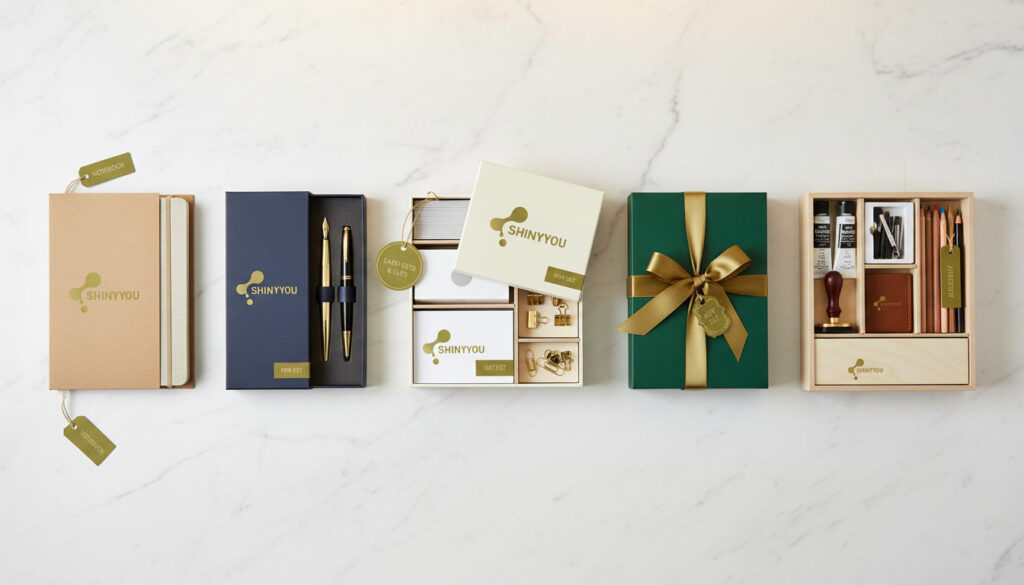
Every product needs a different box — here’s how packaging format maps to product category.
Different stationery products require different stationery packaging approaches. Here is how packaging format typically maps to product category:
Notebooks and journals. Kraft slipcases or rigid boxes work well for premium notebooks. A simple band or sleeve is often sufficient for standard catalogue notebooks where cost efficiency matters more than presentation.
Pen and pencil sets. Slim boxes with foam inserts or molded trays protect writing instruments while presenting them attractively. Pen-specific packaging should account for the precise dimensions of each item to prevent movement during transit.
Card sets and stationery accessories. Compartmentalized boxes with dividers organize sticky notes, paper clips, and small accessories — keeping multi-item sets visually organized and practically usable.
Premium gift sets. Luxurious rigid boxes with foil stamping, ribbon closures, or window cutouts create the gift-worthy presentation that corporate buyers and premium retail customers expect.
Art supply kits. Multi-compartment trays and structured inserts keep diverse components — pencils, markers, brushes — organized and visually appealing within a single branded stationery box.
6. Eco-Friendly Stationery Packaging Options
Nachhaltig stationery packaging has moved from a niche preference to a mainstream procurement requirement in 2026 — particularly for institutional buyers and corporate sustainability programmes. Available eco-friendly options include:
- FSC-certified board — recycled or responsibly sourced paperboard for all box structures
- Recyclable kraft materials — fully recyclable structural packaging with minimal processing
- Compostable and biodegradable coatings — reducing the environmental footprint of finished packaging
- Soy-based and vegetable inks — lower environmental impact than traditional petroleum-based printing inks
- Plastic-free cellulose film windows — maintaining product visibility without plastic components
- Minimalist designs — reducing material usage through efficient structural engineering
According to FSC International, demand for certified sustainable packaging continues to grow year-on-year across global stationery and consumer goods markets. For wholesale buyers supplying European markets, FSC certification on stationery packaging is increasingly tied to the same EUDR compliance requirements that apply to the paper products themselves — making certified packaging a regulatory consideration, not just a sustainability preference.
7. Stationery Packaging for Corporate Gifting
Corporate gifting represents the premium tier of stationery packaging demand — where presentation quality directly correlates with the perceived value of the relationship being honored.
For corporate gift sets, rigid two-piece boxes with soft-touch finishes, magnetic closures, or ribbon ties consistently outperform standard folding cartons in customer perception studies. The packaging should feel substantial in the hand, open with a satisfying motion, and reveal contents in an organized, considered presentation.
Custom inserts that neatly organize pens, notebooks, or accessories within the box elevate the experience further — preventing items from shifting during transit and presenting each component intentionally rather than loosely packed.
8. Stationery Packaging for Retail Display
For retail-facing stationery packaging, the priorities shift toward shelf visibility, structural efficiency, and cost-effective production at scale. Key considerations include:
Shelf consistency. Uniform sizing and consistent print quality across bulk orders give retailers confidence when managing inventory and planogram layouts.
Header panels and hang tabs. Allow products to be displayed on pegboard fixtures common in stationery and office supply retail environments.
Barcode and variant panels. Pre-printed barcode areas streamline retail point-of-sale integration without requiring additional labeling at the point of stocking.
Cost-efficient structures. Tuck-end folding cartons and sleeve-over formats minimize material cost per unit — important for high-volume retail SKUs where margin per unit is already tight.
9. MOQ and Lead Times for Custom Stationery Packaging
Understanding minimum order quantities and production timelines for stationery packaging is essential for planning your wholesale order accurately.
Standard packaging — no customization: Available immediately with stock packaging formats, minimal lead time beyond product production.
Semi-custom packaging — logo printing on standard structure: Typically 15 to 20 days lead time once artwork is approved, with MOQ aligned to your overall product order.
Full custom packaging — bespoke structure and finishes: Requires dieline development, structural proofing, and tooling preparation. Lead times of 25 to 35 days are standard, with the structural proof and dieline approval process adding the most variable time depending on revision rounds.
For wholesale buyers placing a combined order of products and custom stationery packaging, always confirm whether packaging lead time runs concurrent with product production or sequentially after — this materially affects your total order timeline.
10. How to Brief a Stationery Packaging Design Project
A clear brief is the foundation of a successful stationery packaging project. Here is what to include when requesting a custom packaging quote:
- Product dimensions — precise measurements of every item the packaging needs to hold
- Quantity and SKU count — how many units and how many distinct packaging variants are required
- Material preference — cardboard, kraft, rigid, or corrugated based on your positioning and budget
- Structural format — rigid box, folding carton, sleeve, or tray — based on use case and presentation goals
- Brand assets — vector logo files, Pantone color references, and any existing brand guidelines
- Finishing requirements — lamination, foil stamping, embossing, or spot UV preferences
- Sustainability requirements — FSC certification or recyclable material specifications if applicable
- Budget range — helps the manufacturer recommend the right material and finish combination within your cost target
A reputable supplier will provide digital proofs — dieline and 2D or 3D mockups — for approval before production begins, along with physical samples on request for high-value or large-volume orders.
11. Order Custom Stationery Packaging with Shiny You
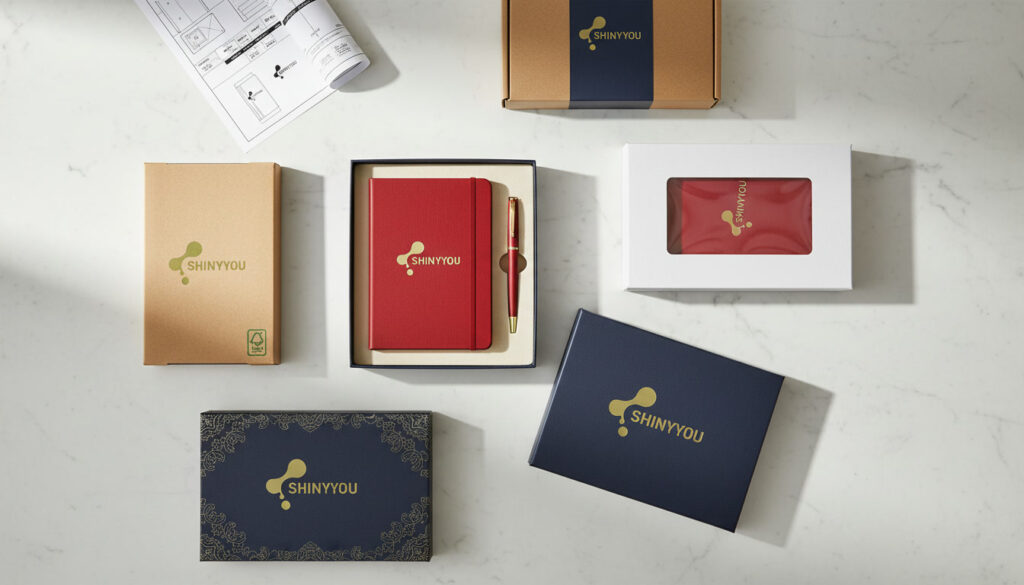
Products and packaging, manufactured together — one coordinated timeline, one trusted partner.
Shiny You Stationery is a professional stationery manufacturer based in Ningbo, China, with nearly 20 years of experience producing both products and the stationery packaging that presents them. Unlike standalone packaging suppliers, we manufacture your stationery products and design your branded packaging together — ensuring perfect fit, consistent branding, and a single coordinated production timeline.
What we offer for custom stationery packaging wholesale orders:
- Full material range — cardboard, kraft, rigid, and corrugated options for every product category
- Complete structural options — rigid boxes, folding cartons, sleeves, trays, and window packaging
- Premium finishing — foil stamping, embossing, soft-touch lamination, and spot UV
- FSC-certified eco-friendly materials — for buyers with sustainability and EUDR compliance requirements
- Integrated production — products and branded stationery boxes manufactured together, with one coordinated lead time
- Free dieline and proof approval — digital mockups provided before mass production begins
Browse our full product range or contact our team at shinyyoustationery.com to discuss your custom stationery packaging wholesale requirements and request a quote within 24 hours.
Great stationery packaging is not an add-on — it is part of the product. When the box and the contents are designed and manufactured together, the result is a coherent brand experience your customers remember. Choose a partner who builds both, together, from day one.