
1. Introduction

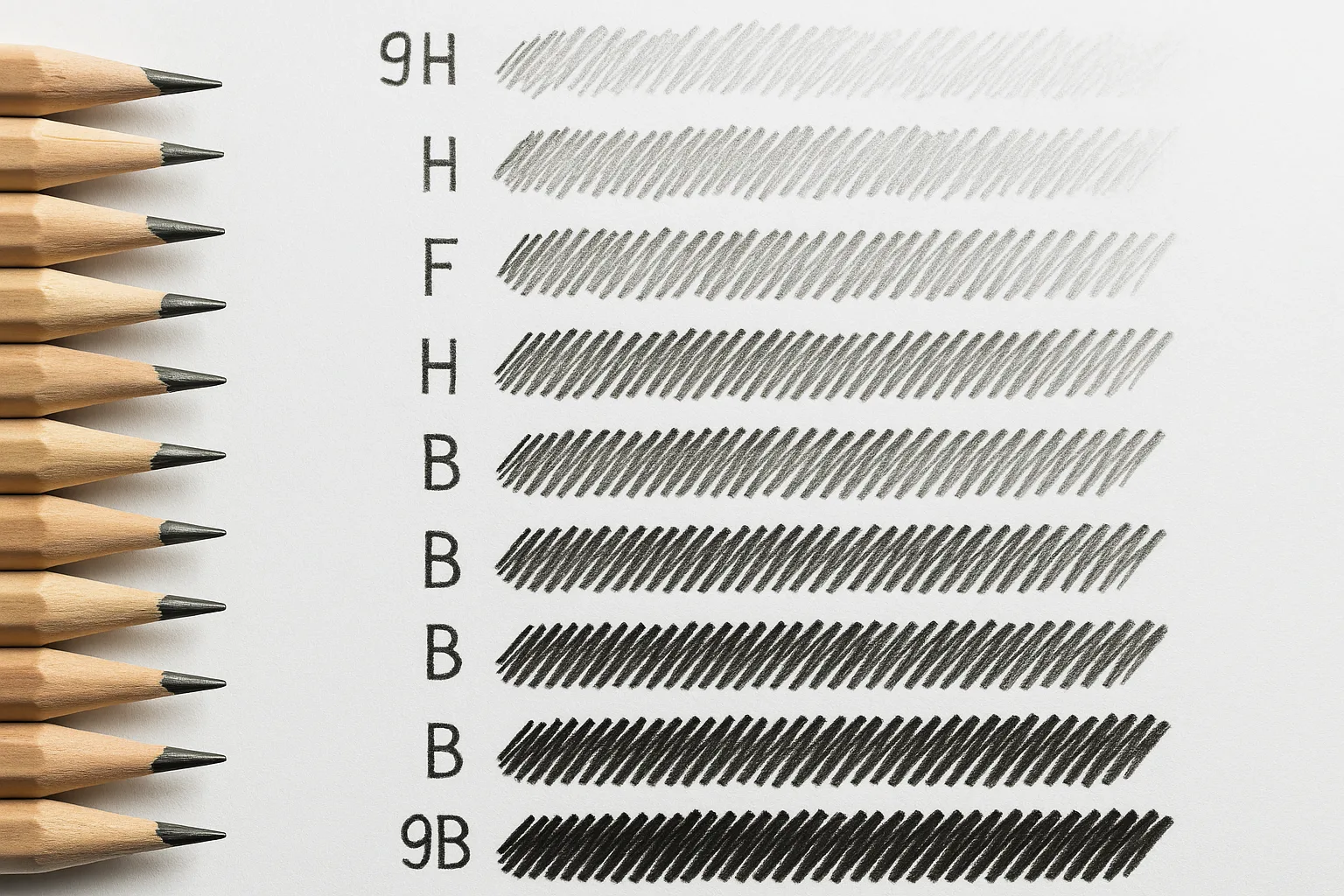
When you pick up a pencil and see markings like “HB,” “2B,” or “4H,” you’re encountering what is commonly called the pencil lead grade — a shorthand label signifying how hard or soft (and correspondingly how dark) that pencil’s mark will be. Despite “lead” being a historical misnomer (modern pencil cores are graphite, not elemental lead), the “grade” aspect remains crucial for artists, engineers, students, architects, and everyday users alike.

Understanding pencil lead grade is more than a curiosity: it can significantly affect your results. Use too soft a lead for technical lines, and you’ll get smudging and lack of precision; use too hard a lead for shading, and your work may look pale or strained. In this article, we will explore the science, the grading systems, how to choose, and how to use different grades effectively.

2. History & Origins

The story begins with graphite, which in the early days was mistaken for a form of lead, giving rise to the term “pencil lead.” Over time, manufacturers discovered that pure graphite was too soft to make a durable core, so they mixed it with clay (or similar binders) to control hardness.

In the early 19th century, Nicolas-Jacques Conte, a French scientist, developed the modern pencil-making method that mixed powdered graphite and clay, then baked the composite to create a strong core. This innovation allowed for systematic adjustment of hardness levels. 

As Bleistifte spread globally, different manufacturers and traditions adopted slightly different nomenclatures, but the core principle—varying the graphite/clay ratio to adjust hardness and darkness—persisted.


3. Composition & Material Science

To understand pencil lead grades deeply, you need to know what’s inside the lead core:

  • Graphit: The pigment that makes the mark. It’s soft, conductive, and gives dark color.

  • Clay (or silicate binder): Adds rigidity and hardness to the core. More clay makes the pencil harder (i.e. lighter, finer lines).

  • Binder or wax / lubricant: Helps the core stay intact, reduce friction, and maintain smooth writing/drawing motion.

The ratio between graphite and clay is pivotal: more graphite → softer, darker lead; more clay → harder, lighter lead. 

Some sources even tabulate approximate compositions. For instance, in a comparative table across grades, pencils at soft end (e.g. 8B) might contain ~90 % graphite, ~4 % clay, and the rest binder, whereas hard pencils (like 4H) invert that ratio.

In mechanical pencil leads (for drafting or Schreibgeräte), polymer or resin binders may partially or fully replace clay to enable slimmer, stronger cores. 

Because graphite is electrically conductive, one might ask: does lead grade affect conductivity? Experiments suggest conductivity is not strictly linear with graphite content, partly due to anisotropic properties of graphite—orientation matters. 

4. Grading Systems: HB, H, B, F, & Numeric Scales

The most widely used scheme is the HB grading scale, combined with variants like H, B, and F:

  • H stands for hardness — leads in this class make lighter, finer marks, resist smudging, and are suited for technical or precise work.

  • B stands for blackness — these leads are softer, deposit more graphite, and yield darker strokes.

  • HB is the midpoint — a balanced compromise between hardness and darkness.

  • F stands for firm (or fine) — it lies between H and HB: somewhat firmer than HB but darker than a pure H in many implementations. 

Each letter grade often carries a numeric prefix (or suffix) indicating the degree of hardness or softness: e.g. 2H, 4H, 2B, 6B, etc. The higher the number attached to H, the harder (and lighter) the mark; conversely, the higher the number attached to B, the softer (and darker). 

In some U.S. educational contexts, pencils are labeled by number (such as #2 pencil), with #2 roughly equivalent to HB in many systems. 

However, there is no universal standard that ensures consistency across brands: two HB pencils from different makers might feel or look quite different. 

Some manufacturers extend the scale to extreme ends (e.g. 10H, 12B) to provide more granular tonal control for artists. 


5. Mapping the Scale: From 9H to 9B (or Beyond)

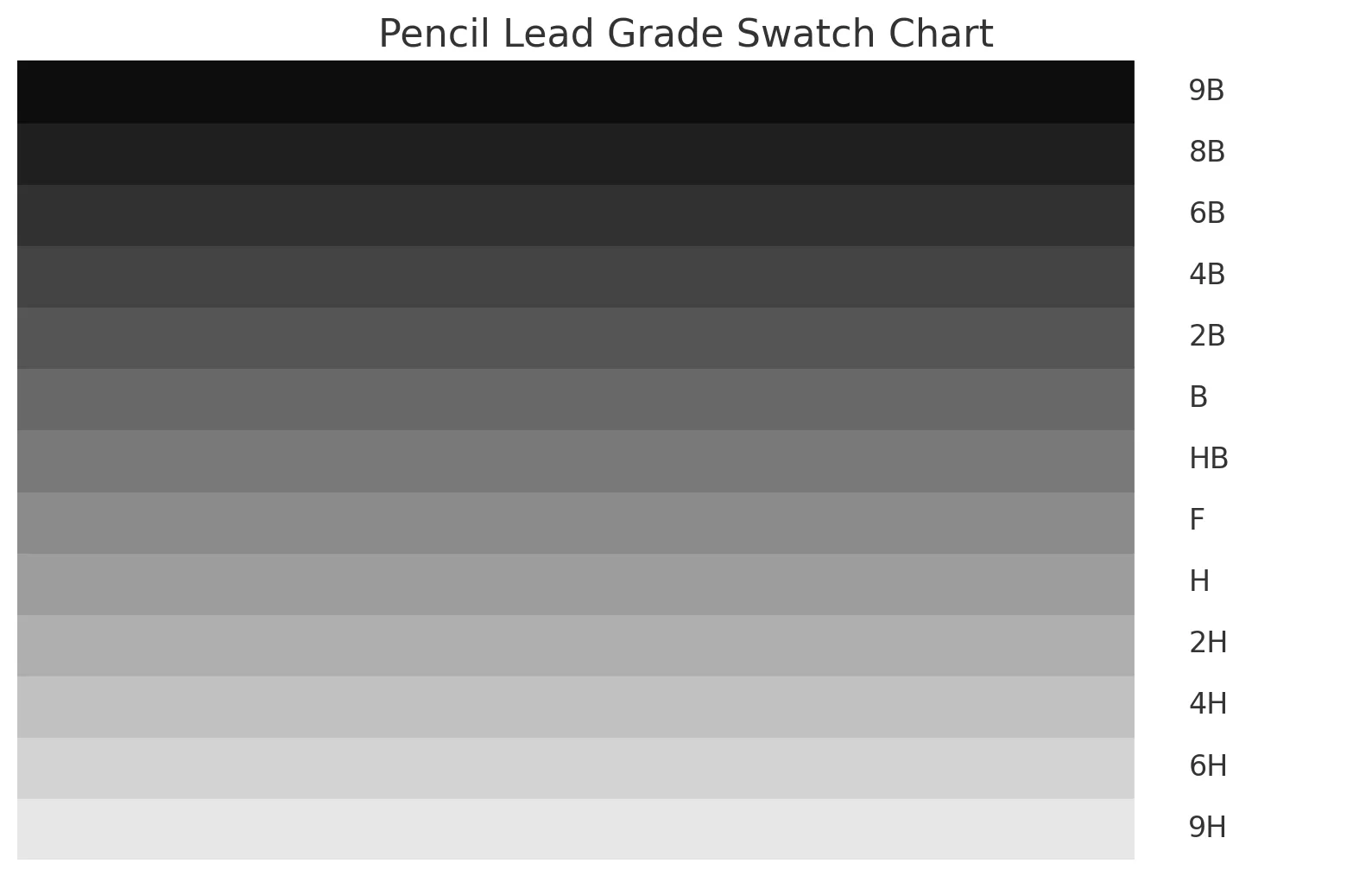
Below is a rough reference table summarizing typical grades and characteristics (note: these are approximate and can vary by brand):

GradeHardness / DarknessPractical BehaviorCommon Uses
9HVery hard / very lighttends to wear slowly, requires higher pressure, faint linetechnical drawing, guidelines
6HHard / lightmore durable tip, light drafting linesarchitects, engineers
4HModerately hardretains point well; lighter shadingtechnical sketches
2HHardgeneral-purpose light drawingpreliminary outlines
HHardfirmer option for controlled linesfine drawing with lighter touch
FFirm / mediumholds good point sharper than HBfine writing/drawing
HBBalancedeveryday writing and sketchingschool, general use
BSoftdarker, smoother marksillustration, mid-range shading
2BSofterricher tone, softer feelexpressive drawing, mid-shades
4BSoft / darkstrong darks, expressive strokesshading, crosshatch
6BVery softdeep blacks, smudges easilymood, atmosphere, expressive art
8B / 9BUltra-soft / very darkheavy coverage, delicate to controldeep shadows, accents
10B / beyondextreme darknesssoftest, high deposit of graphitespecial artistic effect
 

Some art pencil lines go beyond 9B (e.g. up to 12B) to approximate charcoal-like densities. 

From the hard side, some manufacturers go beyond 9H (e.g. 10H) for ultra-fine, faint lines or technical constraints. 

This scale is inherently relative: one brand’s 4B might resemble another’s 3B. The key is how the lead behaves in your hands and on your intended paper.
 

6. Hardness vs Darkness: Tradeoffs & Underlying Physics

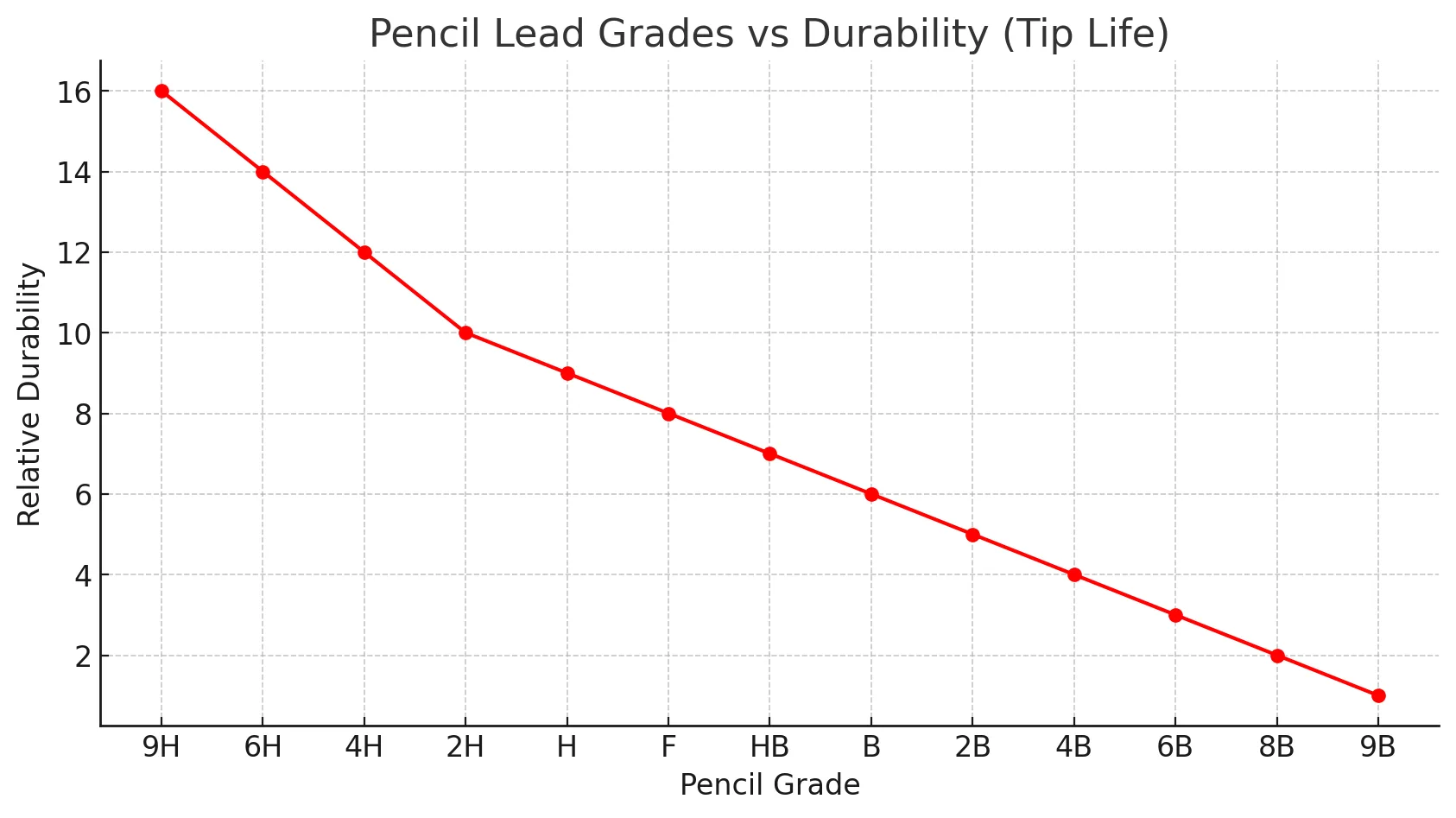
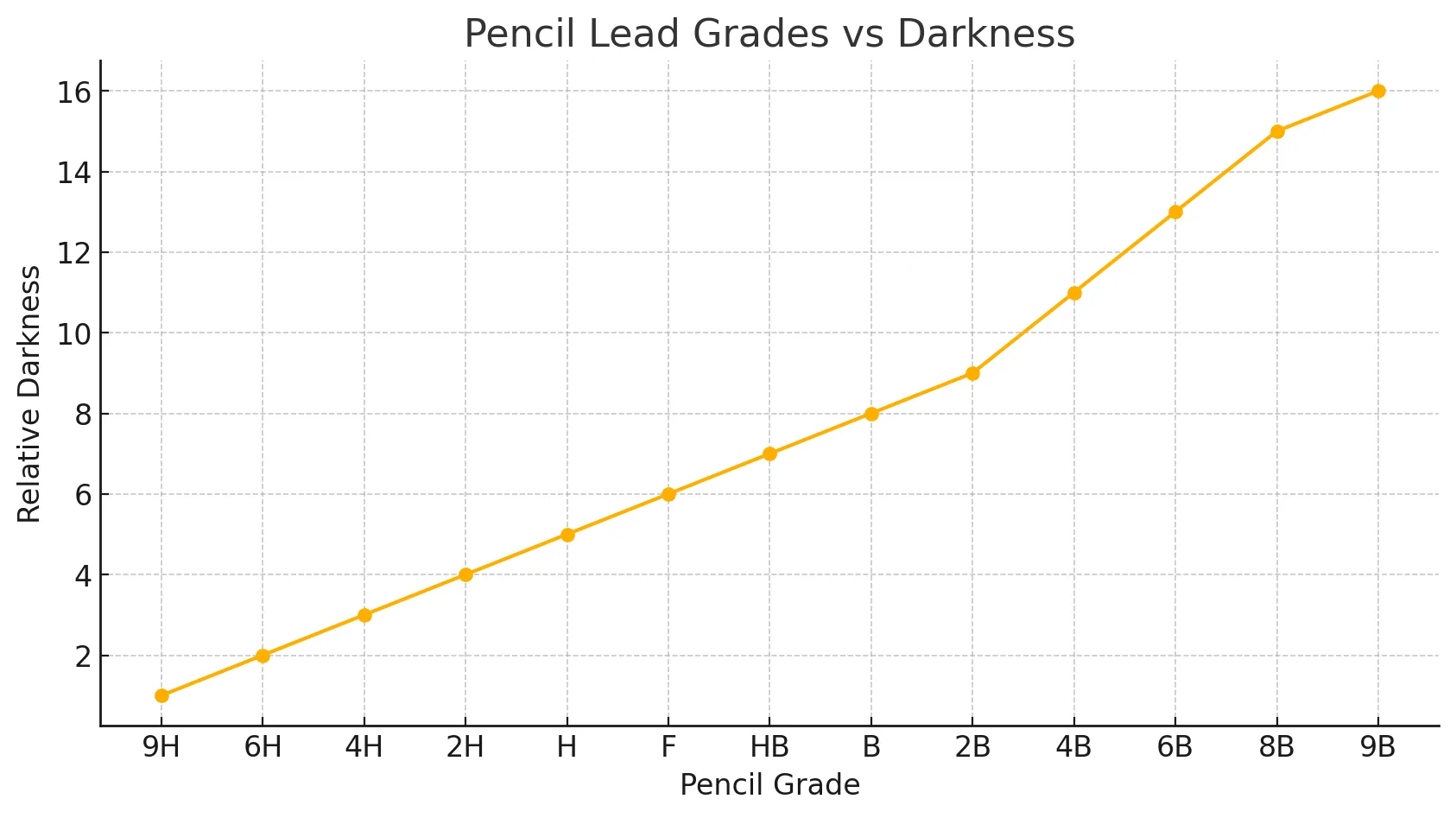
Hardness and darkness are inversely correlated in fairly direct fashion: more clay → harder but lighter; more graphite → softer but darker.

However, the tradeoff is not merely aesthetic:

  • Wear / durability: Hard leads last longer before wearing down; soft leads wear faster and require frequent sharpening or feeding (in mechanical pencils).

  • Smudging: Softer leads smudge more easily; harder leads resist smudge in many contexts.

  • Line control & sharpness: Harder leads hold sharper points, enabling very fine lines; soft leads tend to round or crumble at edges.

  • Pressure sensitivity: Softer leads can yield tonal variation with pressure more easily; harder leads have less dynamic range under pressure changes.

From a physics standpoint, the distribution of particulate graphite, binder or clay grains, and how force fractures or abrades that composite, determines how much material is deposited on paper, how brittle or ductile the lead is, and how sharply it fragments at the tip.

As a curiosity, electrical conductivity experiments of pencil cores show that conductivity depends on more than just graphite content. Because graphite is anisotropic (conductivity varies depending on orientation), and because binder/clay impede electron flow, conductivity vs grade exhibits nonlinear behavior.

Ultimately, the hardness/darkness tradeoff is a balance between strength, smoothness, and expressive potential.


7. Mechanical Pencil Leads vs Wooden Pencil Leads

Many of us use mechanical pencils, which use replaceable “leads” rather than a wooden-encased core. These leads are often 0.5 mm, 0.7 mm, or similar diameters. 

Important distinctions:

  • Binder type: Polymer or resin is sometimes used instead of clay to provide higher tensile strength in thin cores.

  • Grade range: Mechanical pencil leads typically have a more limited grading range (for instance, from 4H to 4B) compared to wood-encased pencils. 

  • Uniformity & consistency: Because they are manufactured in controlled fashion for narrow diameters, mechanical leads often have tighter tolerances in consistency across a single grade.

  • Breakage tendency: Thin leads are more prone to break if overloaded or rigidly pressed; hence, softer grades require a gentler hand.

  • Size constraints: Very soft or very hard grades can be harder to realize reliably in very thin leads due to structural strength limits.

Thus, when working with mechanical leads, you may find a narrower effective range compared to wood pencils. Many serious artists still keep wood-encased pencils for broader expressive control.


8. Practical Use Cases by Discipline

Here’s how different users typically apply different grades:

  • Everyday writing / school use: HB and F are classics; they balance darkness and durability.

  • Technical drawing / drafting: H grades (2H, 4H, etc.) for clean, light guidelines; harder for precision work.

  • Architectural / engineering sketches: Harder grades for outlines; softer for shading or notes.

  • Art & illustration: B series for sketching, shading, expressive strokes; H grades for structural lines or light guides. If your drawing practice involves Buntstifte, you can expand your tonal palette. Likewise, if you work with watercolor pencils, blending and layering techniques add further versatility.

  • Portrait / realism: Wide range from hard to soft — use harder leads for features and outlines, softer leads for shading, smudging, texture.

  • Comic & line art: F, HB, or B for outlines; darker grades (2B, 4B) for fill, contrast, shadows.

  • Graphite-based mixed media: For combining with ink or wash, harder grades may resist smudging into highlights.

In short: many artists maintain a graded set (often spanning 4H to 6B or more), so they can flexibly switch based on context.


9. Paper, Pressure & Technique Interactions

Your choice of lead grade does not exist in a vacuum — the paper you use, the pressure you apply, and your technique all influence outcomes.

  • Paper texture (tooth / smoothness): Rough or highly textured paper “grabs” more from softer leads; very smooth papers may require softer leads to leave visible marks.

  • Weight / thickness: Heavier papers tolerate more pressure or layering without bleed-through.

  • Pressure / hand strength: A lighter hand may benefit from softer leads; a heavier hand may struggle with soft grades (they’ll flatten or crumble).

  • Angle & direction of stroke: Leaning the pencil can increase effective “contact area,” which influences darkness.

  • Layering & blendability: Softer leads are easier to layer and smooth; harder leads less so.

  • Smudging control: Use fixative sprays or barrier sheets when using soft leads for shading, to avoid unintentional smears.

Thus, a 4B pencil on very smooth bristol paper may produce very dark tones easily; the same 4B on rougher paper may struggle to appear dark because of micro gaps.


10. Comparative Chart / Table

Here’s a refined reference you can keep handy (note: approximate ranges):

Grade CategoryExample GradesRelative DarknessRelative Durability / Tip LifeTypical Role
Ultra-hard8H, 9H, 10HVery light / paleLongest tip lifeTechnical layout, guidelines
Hard4H, 2H, HLightHigh durabilityDraft outlines, light sketch
Medium / BalancedF, HBModerateBalanced lifeAll-purpose writing, sketch base
SoftB, 2B, 3BDarkerLower durabilityShading, transitions
Very soft / Expressive4B, 6B, 8B, 9BVery darkShort tip lifeDeep shadows, expressive texture
Extreme soft10B+Deep blackVery soft / crumblySpecial accents, dramatic contrast
 

Remember: these are relative guides, not absolute standards. Try test strokes on your intended paper to calibrate.

11. Brand Variability & Standardization Challenges

Because there is no strict universal standard, there are some practical consequences:

  1. Inter-brand variation: A “HB” from Brand A may feel softer or darker than a “HB” from Brand B. 

  2. Market expectations / regional preferences: Some regions favor softer leads (for richer tone); others prefer firmer leads (for clean precision). 

  3. Batch-to-batch inconsistency: Even within one brand, slight shifts in raw graphite, clay mineralogy, or firing conditions can shift the feel of a grade.

  4. Label inflation/deflation: To market new “extremes,” manufacturers sometimes shift what grade numbers mean internally.

  5. User adaptation: Many artists build a mental calibration of how particular brands’ grades feel; switching brands may require a brief period of adjustment.

In practice, the best strategy is to test and compare leads side by side (same grade from different brands) to see which you prefer.


12. Special Grades & Extremes

While 9H to 9B (or slightly beyond) covers most use cases, advanced or niche pencils push beyond:

  • Ultra-hard beyond 9H: Some manufacturers offer 10H or higher — for extremely faint lines or layout where nearly invisible lines are desired.

  • Ultra-soft beyond 9B: Some art lines go to 12B or more, bordering on charcoal behavior.

  • Hybrid / composite leads: Some leads incorporate charcoal, graphite, or other pigments to expand tonal range or behavior.

  • Graphite + additive leads: Some experimental leads include metal, carbon additives, or magnetic particles for specialty effects (e.g. in art or research). For instance, research has looked at mixing CoFe₂O₄ nanoparticles into pencil cores and observing ferromagnetic effects across grades. 

  • Graphene growth on pencil marks: In an advanced laboratory experiment, pencil marks drawn with lead grades (from 4H through 10B) were used as seeds for multi-graphene growth under laser irradiation. 

Such exotic applications are rarities, but they hint at the breadth and potential extensibility of “pencil lead grade” beyond just art or writing.


13. Testing & Measurement Methods

How can one objectively measure or compare lead grades? Some methods include:

  • Scratch / hardness test: Similar to how coatings are tested; the hardest pencil that doesn’t leave a permanent mark defines a comparative hardness. 

  • Optical density / reflectance measurement: Use a densitometer to measure how dark a stroke is on standard paper under fixed pressure.

  • Conductivity measurement: As mentioned earlier, measuring electrical conductivity of the core gives insight into graphite content—but must consider orientation effects. 

  • Weight loss / abrasion testing: Measuring how much material is worn off from a standardized stroke length under fixed pressure.

  • Microscopic cross-section / composition analysis: Examine the internal structure and ratio of graphite to binder/clay under a microscope or spectrometer.

While these methods exist in research or industrial labs, most users rely on practical side-by-side testing.


14. Tips for Selecting & Using Pencil Grades

Here are practical guidelines:

  • Start with a balanced set: e.g. 2H, H, HB, 2B, 4B, 6B — enough to cover light, mid, and dark needs.

  • Test on your target paper: Try each grade with the same pressure and layering to see what works.

  • Use harder grades for outlines / guides / structure, then overlay with softer grades for shading or tone.

  • Rotate your pencil: Slight rotation of the tip can help maintain a sharp edge or blend tones.

  • Sharpen often (for wood pencils): That ensures cleaner lines, especially for harder grades.

  • Mind smudging: Use a barrier or paper shield when working with B grades; fixatives can help for finished pieces.

  • Store leads carefully (for mechanicals): Temperature, moisture, and mechanical stress can weaken very soft or hard leads.

  • Label & archive: Mark or remember which brand and grade you’re using; consistency helps in reproducibility across works.


15. Common Misconceptions & FAQs

Q1: “Softer leads are always better for drawing.”
A: Not necessarily. Softer leads are great for shading and expressive strokes, but can smudge, flatten, or lose control. Harder leads are better for precision, structure, and clarity.

Q2: “A 2B is just twice as dark as a B.”
A: No — the scale is not linear. Grades represent categorical steps, not linear multiples.

Q3: “All HB pencils are identical.”
A: No — HB is a label, not a standard. Variations in brand, manufacture, and material lead to real differences.

Q4: “My 4B should match another brand’s 4B.”
A: Probably not exactly. Always test and calibrate.

Q5: “Mechanical pencil leads cover the full range of grades.”
A: Typically no. Mechanical leads often offer a narrower range (for strength and reliability) than wood pencils.

Q6: “Sharper is always better.”
A: Only up to a point. Some leads (especially soft ones) will dull quickly or flake if over-sharpened. A slightly rounded but stable tip often yields smoother results.


16. Outlook / Innovations

While the centuries-old system of pencil grading remains robust, there are interesting frontiers:

  • Hybrid and composite leads combining graphite with pigment, charcoal, or metal for special tonal or functional effects.

  • Nano-structured cores: Using graphene, carbon nanotubes, or nano-additives to tailor conductivity or structural strength.

  • Smart / responsive leads: In theory, a lead that changes tonal output based on electric current, pressure sensors, or temperature.

  • Standardization efforts: Some consortia or manufacturers may push toward more reproducible “grade standards” to reduce inter-brand ambiguity.

  • Sustainability & eco-graphs: Leads made from recycled carbon, more benign clay alternatives, or bio-based binders.

These innovations might gradually shift what “pencil lead grade” means in practice, but the core principle — balancing hardness and darkness — remains foundational.


17. Conclusion

The phrase “pencil lead grade” encapsulates a surprisingly rich interplay of materials science, ergonomics, and practical art/engineering use. From the humble HB used in school to ultra-soft 8Bs in expressive drawings or ultra-hard 9Hs in technical layouts, the gradation defines how your pencil interacts with paper and hand.

While the available charts, tables, and scales provide guidance, the ultimate test is always your own hand, tools, and surface. By understanding how grades are constructed (graphite/clay ratio, binder, manufacture), what tradeoffs they involve, and how they interact with paper and technique, you equip yourself to choose or mix grades with intention.

Schreibe einen Kommentar

Deine E-Mail-Adresse wird nicht veröffentlicht. Erforderliche Felder sind mit * markiert