FSC, RoHS, REACH, BSCI: The Certifications Every Wholesale
Stationery Buyer Needs to Know in 2026


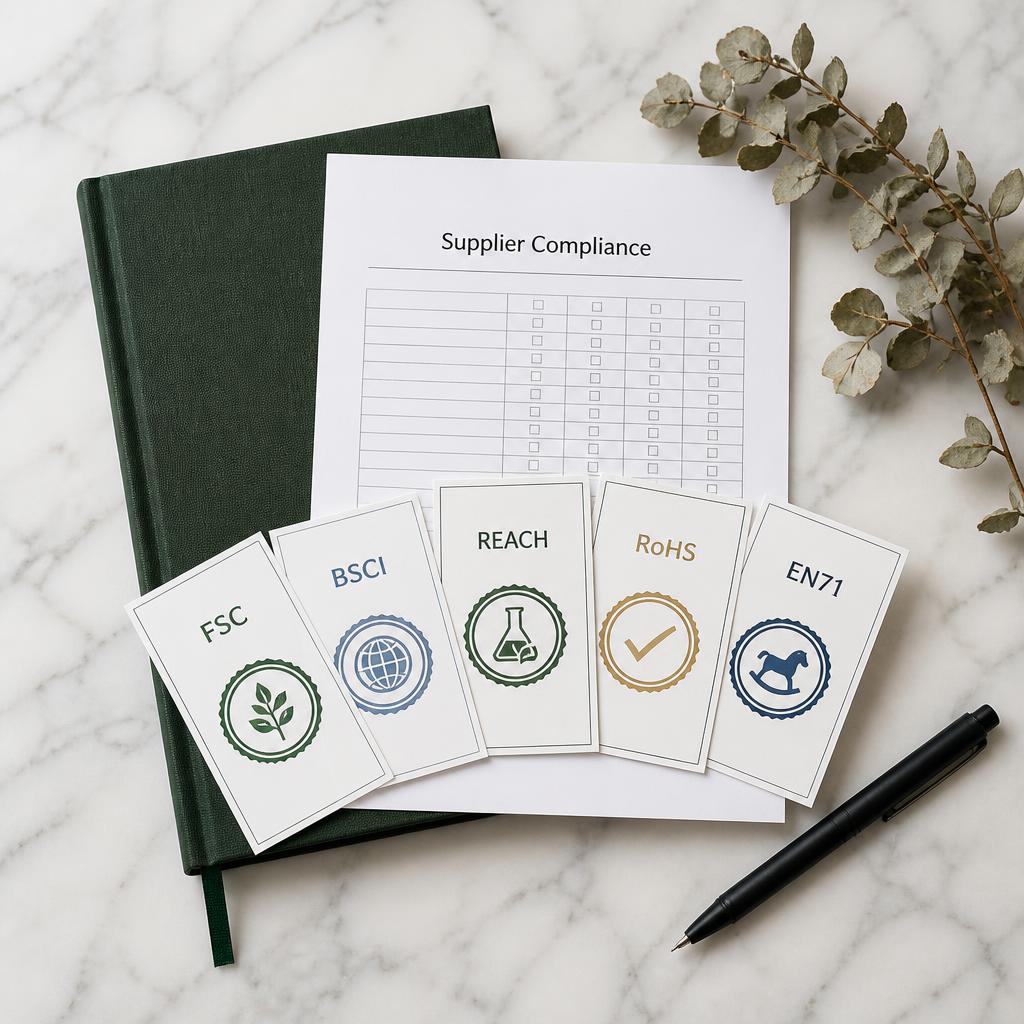
Stationery supplier certifications documents showing FSC BSCI REACH RoHS and other compliance badges on a white marble desk

In 2026, certifications are your stationery product’s passport to market — not optional paperwork.

In 2026, certifications are no longer a nice-to-have for wholesale stationery buyers — they are a procurement prerequisite. Whether you are sourcing notebooks for a European retailer, pens for a US corporate gifting programme, or art supplies for an educational institution, the certifications your supplier holds determine your ability to sell, import, and distribute those products legally and credibly.

Yet most buyers have a limited understanding of what each certification actually means, which ones are mandatory for their market, and how to verify them properly. This guide fixes that — covering every major stationery supplier certification in plain language, with clear guidance on which ones matter for your specific market and products.

Table of Contents

  1. Why Certifications Matter More Than Ever in 2026
  2. FSC Certification — The Sustainability Standard
  3. BSCI Audit — Social Compliance and Ethical Sourcing
  4. REACH Compliance — Chemical Safety for EU Markets
  5. RoHS — What It Means and When It Applies to Stationery
  6. EUDR — The New EU Deforestation Regulation
  7. EN71 — Product Safety for Children’s Stationery
  8. ASTM F963 — US Safety Standard
  9. FDA Compliance — US Market Access
  10. Walmart FCCA and Disney — Retail Chain Requirements
  11. ISO 9001 — Manufacturing Quality Management
  12. How to Verify Certifications Before You Order
  13. Shiny You Certifications — Full Portfolio

1. Why Certifications Matter More Than Ever in 2026

Wholesale stationery buyer reviewing supplier certifications documents including FSC BSCI and REACH compliance on white desk

Regulatory tightening, retail chain requirements, and consumer demand for verified claims are making certifications non-negotiable in 2026.

The global market for testing, inspection, and certification in consumer goods reached USD 37.27 billion in 2026 — with certification services representing the fastest-growing segment, indicating that buyers are increasingly prioritizing verified compliance over self-declared standards.

For wholesale stationery buyers specifically, three forces are driving the urgency around certifications in 2026:

Regulatory tightening. The EU Deforestation Regulation (EUDR) came into force in 2025, adding mandatory deforestation-free sourcing requirements for paper products entering Europe. REACH chemical compliance is actively enforced. EN71 toy safety standards now cover a broader range of stationery products than many buyers realize.

Retail chain requirements. Major retailers — Walmart, Carrefour, Amazon, Tesco — have strengthened their supplier compliance requirements significantly. A wholesale stationery supplier without the right certifications cannot access these retail channels — full stop.

Consumer demand for verified claims. In 2026, buyers and retail partners want verifiable claims, not vague “eco” language. A certification badge from a recognized body is the only form of sustainability claim that serious buyers accept. “Eco-friendly” without certification documentation is a red flag, not a selling point.

2. FSC Certification — The Sustainability Standard

What it is: FSC stands for Forest Stewardship Council. FSC certification verifies that paper and wood-based materials come from responsibly managed forests that meet environmental, social, and economic standards. More than half of consumers worldwide recognize the distinctive FSC logo — making it the most commercially valuable sustainability certification in the stationery category.

Why it matters for stationery buyers: Every paper-based product in your range — notebooks, notepads, journals, folders, and packaging — should carry FSC certification for European and North American market access. FSC certification is now a baseline expectation from institutional buyers, major retailers, and corporate procurement teams globally.

What to check: Verify FSC certificates directly through the FSC public certificate database. A valid FSC certificate shows the manufacturer’s license code, certification scope, and expiry date. Never accept an FSC logo on a website without verifying the underlying certificate is current and covers the specific products you are sourcing.

Key FSC label types:

  • FSC 100% — all materials from FSC-certified forests
  • FSC Recycled — all materials from recycled sources
  • FSC Mix — combination of certified, recycled, and controlled wood

For eco friendly stationery claims to be credible in 2026, FSC certification on all paper-based products is non-negotiable.

3. BSCI Audit — Social Compliance and Ethical Sourcing

What it is: BSCI stands for Business Social Compliance Initiative — now operating under the amfori BSCI system. It is a social compliance audit that verifies how a factory treats its workers, manages labor conditions, and handles environmental responsibilities. BSCI audits issues including worker rights aligned with international labour conventions, with factories receiving a performance rating from A (excellent) to E (unacceptable). Audits are renewed every two years.

Why it matters for stationery buyers: BSCI is a standard requirement for major European retail chains and institutional buyers. Without a current BSCI audit, a wholesale stationery supplier China cannot access Carrefour, Otto Group, or most major European retailers. In March 2026, BSCI received SSCI benchmark recognition — significantly expanding the potential buyer base for BSCI-certified suppliers.

What to check: Request the most recent BSCI audit report including the factory’s performance rating and audit date. An A or B rating is the standard for serious wholesale stationery buyers. Audits older than two years are expired and should not be accepted.

4. REACH Compliance — Chemical Safety for EU Markets

What it is: REACH stands for Registration, Evaluation, Authorisation and Restriction of Chemicals. It is an EU regulation that restricts the use of hazardous substances in products sold within the European Economic Area. For stationery products, REACH compliance covers ink formulations, dye content, plastic components, and coating materials.

Why it matters for stationery buyers: Any stationery product containing restricted substances above threshold concentrations cannot legally be sold in the EU — regardless of how attractive the price or design. REACH non-compliance results in product recalls, import seizures, and significant financial penalties. For wholesale stationery buyers supplying European retailers, REACH compliance documentation is mandatory.

What REACH covers in stationery:

  • Ink and dye formulations in pens, markers, and highlighters
  • Plastic components — pen barrels, ruler materials, eraser compounds
  • Coating and lamination materials on notebook covers
  • Adhesive formulations in glue sticks and correction products
  • Colorant content in colored pencil leads and art supplies

What to check: Request REACH test reports from an accredited third-party laboratory — not self-declarations from the manufacturer. Test reports should be product-specific, dated within the past 12 months, and cover the specific substances of very high concern (SVHC) relevant to your product category.

5. RoHS — What It Means and When It Applies to Stationery

What it is: RoHS stands for Restriction of Hazardous Substances. It is an EU directive that restricts the use of specific hazardous materials in electrical and electronic equipment.

Critical clarification for stationery buyers: RoHS applies exclusively to electrical and electronic equipment. Dinnerware, cookware, and food contact materials are explicitly excluded from RoHS scope. The same principle applies to most stationery products — standard notebooks, pens, pencils, and paper products do not fall under RoHS.

When RoHS does apply to stationery: Any stationery product containing electronic components — smart notebooks with embedded technology, electronic pens, battery-powered desk accessories, or LED-equipped products — must comply with RoHS before entering EU markets. For wholesale stationery buyers sourcing tech-integrated products, RoHS certification is mandatory.

Common mistake: Requesting RoHS certification for standard paper-based stationery wastes time and money. Focus your compliance budget on REACH for chemical safety in standard stationery, and reserve RoHS for electronic-integrated products only.

6. EUDR — The New EU Deforestation Regulation

What it is: The EU Deforestation Regulation (EUDR) came into force in 2025 and requires that paper and wood-based products entering the EU can be proven not to have contributed to deforestation. It applies to all paper products — including notebooks, notepads, packaging, and cardboard components.

Why it matters for stationery buyers: EUDR compliance is now a legal requirement for paper-based stationery entering European markets — not a voluntary sustainability gesture. Importers who cannot demonstrate EUDR compliance for their products face market access denial and significant penalties.

What to check: Your wholesale stationery supplier China must be able to provide geolocation data and supply chain documentation demonstrating that all paper inputs are sourced from non-deforested land. FSC certification significantly supports EUDR compliance — but is not automatically sufficient on its own. Verify EUDR due diligence documentation separately from FSC certificates.

7. EN71 — Product Safety for Children’s Stationery

What it is: EN71 is the European toy safety standard. It covers physical, mechanical, flammability, and chemical safety requirements for products marketed to or used by children under 14.

Why it matters for stationery buyers: A significant portion of stationery products — colored pencils, art supply kits, craft sets, school supply bundles — fall within EN71 scope when marketed for children’s use. EN71 certifications are mandatory for these products in EU markets and are increasingly required by major retailers globally.

EN71 parts relevant to stationery:

  • EN71-1 — mechanical and physical safety
  • EN71-2 — flammability
  • EN71-3 — migration of certain elements (chemical safety)
  • EN71-9 — chemical compounds and chemical mixtures

What to check: Request EN71 test reports from an accredited EU-recognized test laboratory. Reports should be product-specific and cover all relevant parts of the standard for your product type.

8. ASTM F963 — US Safety Standard

What it is: ASTM F963 is the American Society for Testing and Materials standard for toy safety — the US equivalent of EN71. It covers physical, mechanical, flammability, and chemical safety for products marketed to children in the United States.

Why it matters for stationery buyers: For wholesale stationery buyers supplying US retailers with children’s products — school supply sets, art kits, craft supplies — ASTM F963 compliance is mandatory under the Consumer Product Safety Improvement Act (CPSIA). Failure to comply results in import refusal and product recalls.

What to check: Request ASTM F963 test reports and Children’s Product Certificates (CPC) for any stationery products marketed for children in the US market. Test reports must come from CPSC-accepted accredited laboratories.

9. FDA Compliance — US Market Access

What it is: FDA compliance covers US Food and Drug Administration requirements for products that may come into contact with food or be used by or near children. For stationery, FDA compliance is most relevant to ink formulations, colorants, and material compositions in writing instruments and art supplies.

Why it matters for stationery buyers: US retailers — particularly mass market and school supply channels — increasingly require FDA compliance documentation for writing instruments and art supplies as a condition of ranging. It provides an additional layer of safety verification beyond ASTM for buyers supplying regulated US retail chains.

10. Walmart FCCA and Disney — Retail Chain Requirements

What they are: Major retail chains maintain their own proprietary factory audit and compliance programmes beyond standard third-party certifications.

Walmart FCCA (Factory Capability and Compliance Audit) is Walmart’s internal factory assessment programme. Suppliers who want to sell through Walmart — directly or through intermediary retailers — must pass Walmart’s FCCA audit, which covers quality management, ethical sourcing, environmental compliance, and product safety.

Disney compliance certification covers factories producing products featuring Disney intellectual property. The Disney International Labour Standards programme audits factories against Disney’s Code of Conduct — covering labor standards, environmental practices, and health and safety. A Disney-certified wholesale stationery supplier China can produce branded stationery featuring Disney characters for licensed retail distribution globally.

SCAN (Supplier Compliance Audit Network) is used by major US retailers to verify factory compliance with safety and ethical sourcing standards.

Why these matter: If your target retail channels include major chains — Walmart, Target, Disney licensees, or similar — your wholesale stationery supplier must hold the relevant proprietary certifications. These cannot be substituted with standard third-party equivalents.

11. ISO 9001 — Manufacturing Quality Management

 ISO 9001 quality management certification document alongside FSC BSCI and other stationery supplier certifications on white marble

ISO 9001 doesn’t guarantee a specific quality level — it guarantees systematic quality management processes, reducing batch variation on every order.

What it is: ISO 9001 is the international standard for quality management systems. It certifies that a manufacturer has documented, systematic processes in place for consistent quality, customer satisfaction, and continuous improvement. ISO 9001 applies to the organization, not individual products — demonstrating that your company has documented processes for consistent quality, customer satisfaction, and continuous improvement.

Why it matters for stationery buyers: ISO 9001 certification is the baseline quality assurance credential for any serious wholesale stationery supplier China. It does not guarantee any specific product quality level — but it does guarantee that the factory has systematic quality management processes in place, which significantly reduces the risk of inconsistent production, batch variation, and quality surprises on large orders.

ISO 9001:2026 update: The upcoming ISO 9001:2026 revision introduces enhanced leadership accountability, quality culture emphasis, ethical conduct requirements, and more structured risk-based thinking — with a three-year transition period once published in Q3/Q4 2026. When evaluating suppliers, check whether they are preparing for the 2026 revision — it is a signal of operational maturity.

12. How to Verify Certifications Before You Order

Knowing which certifications to look for is only half the battle. Verifying them properly before placing a wholesale stationery order is equally critical. Here is a practical verification process:

Step 1 — Request original documents. Never accept certification claims based on logo badges on a website or catalogue. Request original certificate documents — PDF copies with certificate codes, issuing body details, scope of certification, and expiry dates.

Step 2 — Verify through official databases. For FSC, verify through the FSC public certificate search at search.fsc.org. For BSCI, verify through the amfori platform. For ISO 9001, verify through the issuing certification body’s registry. Official databases are the only reliable source of current certification status.

Step 3 — Check scope carefully. A certification covers specific products, processes, or facilities — not a manufacturer’s entire business. Verify that the certification scope explicitly covers the specific products you are sourcing, not just the factory’s headquarters or a different product division.

Step 4 — Check expiry dates. Certifications expire. An FSC certificate that expired six months ago provides no compliance protection for your current order. Always verify that certificates are current — not historical.

Step 5 — Match certifications to your target market. Different markets require different certifications. EU buyers need FSC, REACH, EUDR, EN71, and BSCI. US buyers need ASTM F963, FDA, and CPSIA compliance. Build a market-specific certification checklist and verify each item before approving a new supplier.

13. Shiny You Certifications — Full Portfolio


Shiny You Stationery full certifications portfolio showing FSC BSCI EUDR FDA Walmart FCCA SCAN and Disney certification badges

Shiny You holds a full portfolio of current, verified certifications — available as original documents on request, not logo badges.

Shiny You Stationery is a professional wholesale stationery supplier based in Ningbo, China, with nearly 20 years of manufacturing experience and one of the most comprehensive certification portfolios in the industry. Our full certifications are available for verification on request:

  • FSC — Forest Stewardship Council certification for all paper-based products
  • BSCI — Business Social Compliance Initiative audit — current rating available on request
  • EUDR — EU Deforestation Regulation compliance documentation
  • FDA — US Food and Drug Administration compliance for relevant product categories
  • Walmart FCCA — Factory Capability and Compliance Audit
  • SCAN — Supplier Compliance Audit Network certification
  • Disney — Disney International Labour Standards programme compliance

All certification documentation is available as verified original certificates upon request — not logo badges or self-declarations. We maintain current certifications across all categories and renew proactively before expiry.

For eco friendly stationery buyers with specific certification requirements — including EN71 for children’s products, ASTM F963 for US markets, or REACH test reports for EU chemical compliance — our team can provide product-specific documentation for any item in our range.

Browse our full product range or contact our team at shinyoustationery.com to request our full certification portfolio and discuss your compliance requirements.

In 2026, certifications are not paperwork — they are your product’s passport to market. Choose a wholesale stationery supplier China who treats compliance as a competitive advantage, not an afterthought. Choose a partner whose certifications are verified, current, and comprehensive. Choose Shiny You.