

Wholesale Stationery MOQ: What You Need to Know Before Placing Your First Order
Wholesale Stationery MOQ: What You Need to Know Before Placing Your First Order
Every first-time buyer runs into the same acronym almost immediately: MOQ. Understanding wholesale stationery MOQ before you request your first quote saves you from the most common first-order surprises — a number that’s higher than expected, a deposit structure you didn’t plan for, or a product mix that doesn’t match your actual budget.
This guide is built specifically to walk through wholesale stationery MOQ from a first-timer’s perspective, not a general sourcing overview.
This guide covers what MOQ actually means for stationery buyers specifically, typical ranges by product type, how it affects your cash flow, and a practical checklist to work through before you place your first order.
Table of Contents
- What MOQ Actually Means and Why It Exists
- Typical Wholesale Stationery MOQ Ranges by Product
- How MOQ Affects Your Budget and Cash Flow
- Samples vs MOQ: What Happens Before You Commit
- A Worked Example: Sizing Your First Order
- Payment Terms and Deposits Tied to MOQ
- What If You Can’t Meet the MOQ
- Your First MOQ Conversation: What to Actually Say
- Common First-Order Mistakes Around MOQ
- A Pre-Order Checklist Before You Commit
- Calculating the True Cost of Your MOQ Commitment
- How MOQ Typically Changes After Your First Order
- How Shiny You Handles First Orders
- FAQ
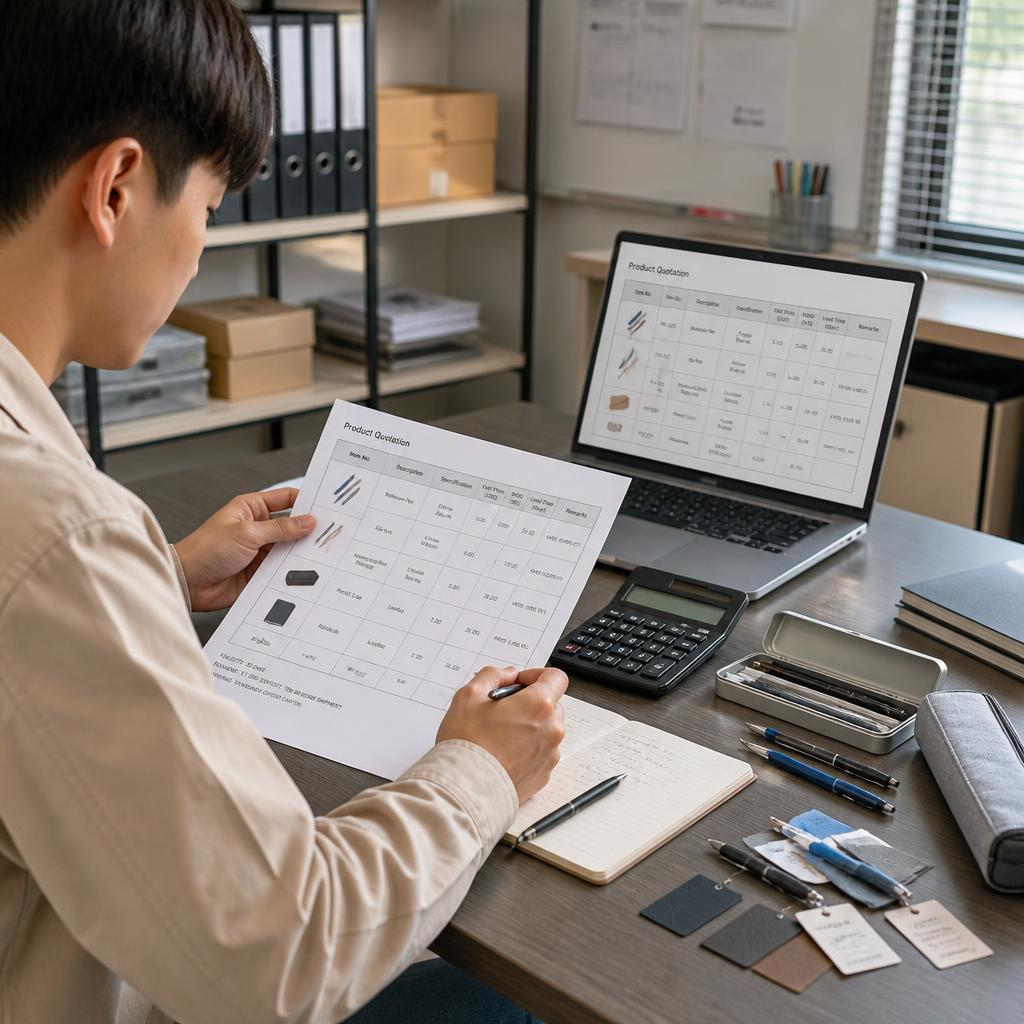
[IMAGE 1 — a first-time buyer reviewing a supplier quote sheet at a desk, calculator and notebook nearby. Suggested alt text: “wholesale stationery MOQ first order quote review”]
Understanding wholesale stationery MOQ before requesting your first quote helps you budget accurately from the start.
1. What MOQ Actually Means and Why It Exists
MOQ stands for Minimum Order Quantity, the smallest number of units a supplier will produce in a single run. It isn’t an arbitrary gatekeeping number; it exists because manufacturing has real fixed costs, machine setup, material procurement, tooling, that only make financial sense above a certain volume. Every conversation about wholesale stationery MOQ ultimately traces back to this basic economic reality on the supplier’s side.
For a first-time buyer, wholesale stationery MOQ represents the floor of what’s commercially viable for a supplier to produce, not a target they’re hoping you’ll exceed. Understanding this framing matters because it changes how you negotiate: asking a supplier to explain why their MOQ sits where it does usually gets a more useful answer than simply asking for a lower number.
2. Typical Wholesale Stationery MOQ Ranges by Product
MOQ varies significantly across stationery categories, and knowing rough ranges in advance helps you set realistic expectations before your first conversation with a supplier:
- Notebooks and paper products: often the most flexible category, with MOQ starting around 300 to 500 units for catalogue designs.
- Pens and writing instruments: typically 500 units for branded or custom-color orders, given standardized assembly lines.
- Pencil cases and bags: usually higher, often 1,000 to 3,000 units, due to fabric or molded material tooling costs.
- Fully custom OEM products: the highest tier, frequently 3,000 units or more, since tooling and design setup only pay off at volume.
These ranges shift based on customization level, and a wholesale stationery MOQ quote for an existing catalogue item will almost always sit lower than the same product built from a fully custom design. Knowing these rough figures before your first supplier conversation helps you evaluate whether a quoted number is reasonable for what you’re actually asking for.
3. How MOQ Affects Your Budget and Cash Flow
MOQ isn’t just a production number, it’s a direct claim on your available capital. A 1,000-unit MOQ at $2 per unit means $2,000 tied up in inventory before a single item sells, plus freight, duties, and storage costs on top.
First-time buyers frequently underestimate this. Understanding wholesale stationery MOQ as a cash flow decision, not just a production requirement, changes how you approach your first order.
A useful gut check: could your business comfortably absorb this inventory sitting unsold for three to six months if sales come in slower than expected?
O U.S. Small Business Administration’s guide to managing business finances covers this kind of cash flow planning in more general terms, and the same logic applies directly to inventory tied up in a wholesale order. If the honest answer is no, a smaller trial quantity or a lower-tier product is usually the better starting point.
4. Samples vs MOQ: What Happens Before You Commit
[IMAGE 2 — a small sample box of stationery products being compared against a full production run of boxes in a warehouse. Suggested alt text: “wholesale stationery MOQ samples versus bulk order”]
A pre-production sample confirms quality before committing to the full wholesale stationery MOQ.
Samples exist specifically to de-risk the gap between “this looks good in photos” and “this is actually what I want to sell at volume” once your full wholesale stationery MOQ order is committed. Most suppliers offer samples at a small quantity, sometimes just one or two units, well below their standard MOQ, often at a modest cost that’s separate from the bulk order pricing.
Never skip this step, even under time pressure. A supplier’s willingness to produce a proper pre-production sample before you commit to full wholesale stationery MOQ is itself a useful signal about how seriously they take quality control on your actual order. Buyers who skip this step to save a week or two often lose far more time later dealing with a bulk shipment that doesn’t match expectations.
5. A Worked Example: Sizing Your First Order
Abstract numbers are easier to apply with a concrete scenario attached, so here’s how a realistic wholesale stationery MOQ decision plays out for a first-time buyer. Consider a first-time buyer planning to launch a small stationery line through an online store and two local gift shop accounts.
Rather than committing to a supplier’s standard 3,000-unit wholesale stationery MOQ for a fully custom notebook design, this buyer instead selects an existing catalogue cover design available at 300 units, keeping the total commitment small enough to test real demand across both sales channels within a single season.
The math works out roughly as follows: 300 units at $2.50 per unit comes to $750 in product cost, plus an estimated $200 in freight and duties for a small first shipment, bringing total landed cost to approximately $950. At a modest retail markup, this becomes a manageable first-order risk rather than a multi-thousand-dollar commitment on an unproven design.
If the design sells through within the first two months, the buyer has real sales data to bring to their next conversation, at which point a larger order, or a move to semi-custom branding, becomes a far more informed decision than committing to that wholesale stationery MOQ volume upfront would have been.
6. Payment Terms and Deposits Tied to MOQ
Standard industry practice for a first wholesale order typically follows a 30% deposit on order confirmation, with the remaining 70% due before shipment or against shipping documents. This deposit is usually calculated against the full order value, meaning a higher wholesale stationery MOQ directly increases your upfront cash commitment before you’ve received anything.
Understanding this connection between wholesale stationery MOQ and deposit size matters for first-time buyers specifically, since it’s easy to focus on unit price and MOQ in isolation without calculating what the combined deposit actually requires from your available cash on hand.
7. What If You Can’t Meet the MOQ
A published wholesale stationery MOQ isn’t always as fixed as it looks. A few realistic options if a supplier’s standard minimum exceeds your first-order budget:
- Ask about trial quantities. Many manufacturers offer a reduced entry point, sometimes as low as 5 cases, specifically for buyers testing a new relationship.
- Combine multiple designs under one MOQ. Ordering several colorways or patterns of the same base product, rather than one design at full volume, spreads the commitment without exceeding your budget.
- Choose a catalogue product over a custom one. Existing designs almost always carry a lower wholesale stationery MOQ than anything requiring new tooling.
- Look for a supplier with production run entry. Some manufacturers let smaller orders join an already-scheduled production run for a specific design, avoiding the need to trigger a full standalone run.
8. Your First MOQ Conversation: What to Actually Say
Knowing that MOQ has some flexibility doesn’t help much without knowing how to raise it in an actual conversation. A few practical approaches that work well for first-time buyers specifically:
Lead with context, not just a request. Telling a supplier “I’m testing this design in a small retail location before committing to a larger seasonal order” gives them a reason to consider flexibility that a bare “can you lower your MOQ” request doesn’t provide.
Ask what the next order looks like before committing to the first one. If a supplier offers a reduced trial quantity, confirm what MOQ and pricing apply on your second order if the trial goes well, so a favorable first deal doesn’t turn into an unworkable second one.
Be specific about your constraint. A buyer who says “my budget for this first order is capped at $3,000 including deposit” gives a supplier something concrete to work with, compared to a vague request for “your best price,” which rarely produces useful flexibility around wholesale stationery MOQ specifically.
9. Common First-Order Mistakes Around MOQ
A few patterns show up consistently among first-time buyers navigating MOQ for the first time:
- Comparing MOQ numbers without comparing what they include. A lower wholesale stationery MOQ with a higher per-unit price and no included branding isn’t necessarily the better deal once the full order is calculated.
- Not asking whether MOQ applies per design or per order. This distinction can significantly change your actual commitment across a multi-SKU first order.
- Committing to full custom before confirming demand. A fully custom product’s higher MOQ concentrates risk exactly where a first-time buyer can least afford it.
- Ignoring packaging MOQ until late in the process. Custom packaging frequently carries its own separate minimum from the product itself.
- Underestimating total landed cost. Freight, duties, and storage all sit on top of the unit price and MOQ commitment, and skipping this calculation leads to budget surprises after the order ships.
Buyers newer to the broader sourcing process may also find it useful to review this guide to choosing a stationery manufacturer and this guide to finding reliable stationery wholesalers alongside MOQ specifically, since supplier reliability and MOQ flexibility tend to go hand in hand.
10. A Pre-Order Checklist Before You Commit
Before placing your first order against a quoted wholesale stationery MOQ, confirm each of the following — this checklist works whether you’re ordering 300 units or 3,000:
- You’ve received and approved a physical pre-production sample, not just photos
- You understand whether MOQ applies per design, per color, or across your total order
- You’ve calculated the full deposit amount, not just the per-unit price
- You’ve confirmed lead time and realistically compared it against any deadline you’re working toward
- You’ve asked about packaging MOQ separately from product MOQ
- You’ve reviewed the supplier’s certifications relevant to your target market, covered in more detail in this stationery manufacturer certifications guide
Working through this list before signing off on a quote takes an hour, maybe two. Skipping it and discovering a gap after your wholesale stationery MOQ order has already shipped typically costs far more than that in time, money, or both.
This kind of staged approach, sample first, small trial quantity next, full MOQ only once confidence is established, mirrors the broader thinking covered in this MOQ strategy guide for buyers who want to go deeper on negotiating flexibility specifically.
11. Calculating the True Cost of Your MOQ Commitment
[IMAGE 3 — a spreadsheet or calculator showing unit cost, freight, and duties added up next to boxed stationery product. Suggested alt text: “wholesale stationery MOQ landed cost calculation”]
Unit price is only one part of what a wholesale stationery MOQ commitment actually costs.
The quoted unit price is rarely the full cost of meeting a supplier’s wholesale stationery MOQ. A complete picture requires adding freight, import duties, and any storage cost until the inventory sells, a calculation sometimes referred to as landed cost.
This concept overlaps with the classic Economic Order Quantity model covered by the Corporate Finance Institute’s EOQ explainer, which balances ordering costs against holding costs.
You don’t need to run a formal EOQ calculation to benefit from the underlying logic when sizing a wholesale stationery MOQ commitment: every unit above what you can realistically sell within a reasonable window is capital that isn’t available for anything else in your business.
A practical way to estimate landed cost before committing to an order:
- Start with the quoted unit price at your MOQ
- Add estimated freight cost, which varies significantly by shipping method and current market rates
- Add applicable import duties for your destination country and product category
- Add a rough estimate of storage cost for however long the inventory is likely to take to sell through
Comparing this total landed cost, not just the quoted unit price, across different MOQ tiers and suppliers gives a far more accurate picture of what your first order actually requires financially.
12. How MOQ Typically Changes After Your First Order
O wholesale stationery MOQ quoted for your first order isn’t necessarily what you’ll see going forward, and understanding this trajectory helps set realistic long-term expectations rather than assuming every future order carries the same constraints as the first.
Suppliers generally extend more flexibility to buyers with a track record of following through on commitments.
A buyer who places a modest first order, pays on time, and communicates clearly through the process is typically in a stronger position to negotiate on their second or third order than they were on day one.
This isn’t a formal policy at most manufacturers so much as a natural byproduct of trust building over repeated wholesale stationery MOQ transactions.
Order history also gives you leverage that a first-time buyer simply doesn’t have access to.
Once you can point to a completed order and a realistic sales forecast based on actual performance, rather than a projection, conversations about combining designs, reducing MOQ for a new SKU, or negotiating better payment terms tend to go differently than they did during your first wholesale stationery MOQ negotiation.
This is part of why treating your first order as the start of a relationship, not just a one-off transaction, tends to pay off.
Buyers who approach wholesale stationery MOQ negotiations this way, prioritizing a smooth first order over squeezing the lowest possible price or MOQ out of a brand-new supplier relationship, generally end up with better terms within their first few reorders than buyers who treat every order as an isolated negotiation.
13. How Shiny You Handles First Orders
Shiny You Stationery structures MOQ specifically to support first-time buyers, with catalogue products starting from 300 units and trial-quantity entry available for buyers testing a design before committing to a full production run. Our overview of how MOQ and onboarding works walks through what a first conversation with our team typically looks like, and our broader 10-step wholesale sourcing guide covers the full first-order process alongside MOQ specifically.
For buyers exploring our full range before requesting a quote, our stationery catalogue and this list of stationery manufacturers worth knowing about are both useful starting points for comparing options. Buyers considering a specific product category first, such as our gel pen wholesale range or our kawaii stationery collections, can also review those category-specific guides for MOQ figures relevant to that product type.
14. FAQ
What is a typical MOQ for a first wholesale stationery order?
This varies by product, but catalogue notebooks and pens often start around 300 to 500 units, while custom or bundled products typically start higher, from 1,000 to 3,000 units.
A quoted wholesale stationery MOQ outside these ranges is worth asking a supplier to explain, since it may signal a fully custom product or a bundled minimum you weren’t expecting.
Can MOQ be negotiated for a first-time buyer?
Often, yes. Trial quantities, combining multiple designs under one MOQ, and choosing catalogue products over full custom are all common ways first-time buyers reduce their effective wholesale stationery MOQ commitment.
How much deposit should I expect to pay?
Standard practice is a 30% deposit on order confirmation, with the remaining 70% due before shipment, calculated against your full order value including your MOQ commitment.
Should I ever skip the sample stage to save time?
No. Samples exist specifically to catch quality issues before you commit to full wholesale stationery MOQ, and skipping this step is one of the most common causes of costly first-order mistakes.
Does MOQ apply per design or across my whole order?
This depends on the supplier, and it’s worth confirming explicitly, since some suppliers allow combining multiple designs to reach one combined MOQ, while others apply it strictly per design.
What happens if I can’t sell through my full MOQ?
This is exactly the risk a smaller trial quantity is designed to prevent. Starting with a catalogue product at a lower MOQ, rather than a full custom order at a higher one, keeps this risk manageable for a first order specifically.
Is unit price or MOQ more important when comparing suppliers?
Neither in isolation tells the full story. Calculating total landed cost, unit price plus freight, duties, and storage across your full wholesale stationery MOQ commitment, gives a far more accurate basis for comparison than either number alone.
Should I request quotes from multiple suppliers before committing?
Yes. Comparing MOQ, pricing structure, and what each quote actually includes, samples, packaging, branding, across two or three suppliers is standard practice and helps first-time buyers avoid anchoring on the first number they receive.
Does my wholesale stationery MOQ stay the same on future orders?
Not necessarily. Suppliers often extend more flexibility to buyers with a proven order history, so the terms on your second or third order may differ meaningfully from your first, usually in your favor once trust is established.