

South Africa School Stationery: Back-to-School Ordering
South African school stationery is a January business. Term 1 opens in the second week of January, school lists go out in December, and by the time the shelves empty in the first week of term the production window for that season has already closed. Buyers who treat the South African season like the northern-hemisphere July–August peak end up either air-freighting a partial range or waiting a year.
This guide sets out how to plan a South African school stationery programme: the calendar the order hangs from, the formats that actually appear on school lists, the specification decisions that decide cost, and the lead times and documents that keep a January delivery date intact.
Table of Contents
- Start from the school calendar, not the trade calendar
- What South African school lists actually ask for
- The January window, counted backwards
- Choose the order route before comparing prices
- Paper, ruling and page count
- Binding and covers for high-volume school books
- Bundling into class packs and retail-ready units
- Quantities, MOQ and the quotation
- Documents schools and buyers ask for
- Brief template and next step
1. Start from the school calendar, not the trade calendar
South Africa’s public-school year runs January to December, and the Department of Basic Education publishes the term dates years ahead. For 2027 the learner year opens on 13 January and closes on 8 December, with Term 1 ending 19 March, Term 2 running 6 April–25 June, Term 3 20 July–22 September and Term 4 5 October–8 December. (South African Government school calendar; DBE 2027 calendar PDF)
Three consequences follow, and all three shape purchasing:
- The retail peak is late December to mid-January, not January to February. Stock has to be in the country, cleared and distributed before the lists are handed out.
- Restocking is a February problem, not a January one. Once term starts, only stock already in the warehouse can refill a shelf.
- The 2028 dates may already be published when you plan. Confirm them for the specific year you are buying for rather than reusing last year’s calendar.
2. What South African school lists actually ask for
School lists vary by school, province and grade, so the useful exercise is to collect the lists from the schools or chains you supply and build the range from the recurring items rather than from a general "school stationery" assumption. In published lists and retail ranges, the items that recur are:
| Item type | Common specification seen on lists |
|---|---|
| Exercise books | A4, 72 pages, feint and margin; 32- and 48-page versions for younger grades |
| Quad books | A4, 72 pages or 192 pages (2 quire), quad and margin |
| Hard-cover books | A4 counter books, 96, 192 and 288 pages |
| Files and covers | A4 flip files (20, 50 pocket), ring or lever-arch files, slip-on plastic book covers |
| Writing | HB pencils, ballpoint pens, coloured pencils, wax crayons |
| Adhesives and tools | Glue sticks, erasers, sharpeners, scissors, rulers |
| Carriage | Pencil cases and pouches, often with a named or colour-coded format |
A published Grade 4–6 list from a South African school, for example, specifies multiple A4 72-page feint-and-margin books, 192-page quad books, 20-pocket flip files, slip-on covers and a hard-cover A5 book in the same brief. (sample school stationery list)
The design implication is important: a South African school range is a page-count and ruling matrix, not a cover-design story. The same cover artwork has to work across 32, 72, 192 and 288 pages, and the buyer needs to see the matrix before approving anything.
3. The January window, counted backwards
Work backwards from the date the goods must be on a retail shelf, and treat each milestone as separate rather than as one "production time":
| Step | What has to be true |
|---|---|
| Range and specification approved | Formats, page counts, paper, ruling and covers fixed |
| Samples approved | Sampling runs from 24 hours to 14 days depending on product and process |
| Production | Approximately 10–45 days, confirmed per project |
| Inspection and packing | AQL 2.5 sampling to ISO 2859-1, against the approved sample |
| Freight and clearance | Quoted per sailing and per destination — add it to the plan, do not assume it |
| Distribution to stores | Before school lists are issued in December |
Two calendar facts make this harder than a simple arithmetic exercise.
Chinese New Year. In 2027 the holiday falls on 6 February, with production slowing from mid-January and capacity returning gradually through February and into March. (CNY 2027 factory shutdown pattern) Any order intended to ship in late January has to be completed before the pre-holiday slowdown, which pulls the production start back into December.
The pre-Christmas freight peak. November and December are the most congested weeks of the year on most lanes. An order that finishes production in mid-December competes for space with every other seasonal shipment.
Put together, the practical planning window for a January shelf date is: specification and samples confirmed by August, production order placed by September, goods completed by November, freight and clearance in November–December. Buyers planning the January 2027 season in November 2026 are already past the full-custom window; for that season the realistic routes are a stock range from existing cartons, or a partial range with expedited freight. The next full cycle should be planned from the 2028 calendar.
4. Choose the order route before comparing prices
| Route | What you get | Best for | Constraint |
|---|---|---|---|
| Stock range | Existing school formats, ordered from one carton per product | Testing a school channel, filling a gap mid-season, tender top-ups | Limited to designs and specs already in the range |
| Semi-custom | Existing construction with new cover print, colour, school or chain branding, packaging | Own-label school ranges without new tooling | Changes must fit the existing format |
| Full custom (OEM/ODM) | New trim, paper, page count, ruling, cover material, binding and packing | Chains, wholesalers and brands with a defined shelf concept | Development time, tooling and a higher minimum quantity |
Most buyers start with a stock or semi-custom range, then move the fastest formats into full custom once sell-through by page count is known. The school stationery manufacturing route sets out the development sequence, and the wholesale supply route covers range-based buying.
5. Paper, ruling and page count
Exercise books are a price-point product, so the paper decision is usually made by the target retail price rather than by preference.
- 70–80 GSM suits entry price points and high-volume exercise books, with the trade-off of show-through on wet inks.
- 90–100 GSM is the mainstream retail choice for notebooks and journals.
- 100 GSM and above suits fountain-pen users and premium formats, but adds freight weight across a pallet of 72-page books.
Ruling and margins matter more than paper weight on a school list, because the book has to match what the teacher asked for:
- Feint and margin is the standard requirement for language and general work.
- Quad and margin appears for mathematics and science, often at 72 or 192 pages.
- Margin width, ruling pitch and page numbering should be confirmed on a physical sample. A PDF proof will not show the ruling weight or show-through at real scale, and a 1 mm margin difference is visible to a teacher.
Recycled and FSC-certified paper can be reviewed as sourcing options on suitable products; the specification and any supporting document are confirmed for the selected product, mill and order rather than assumed across a range.
6. Binding and covers for high-volume school books
School books are chosen for cost and durability in that order, which narrows the binding decision:
| Binding | Practical page range | Where it fits |
|---|---|---|
| Saddle stitch | Approx. 32–64 pp | Thin exercise books and booklets |
| Perfect binding | Approx. 64–192 pp | Standard exercise books and counter books |
| Wire-O / spiral | Approx. 70–200 pp | Books that must lie flat on a desk |
| Sewn case-bound hardcover | Approx. 96–288 pp | Counter books and long-life hard covers |
Covers are usually 250–300 GSM board with matt or gloss lamination. For a school range, three things decide whether the cover survives the year:
- Lamination choice against handling. Soft-touch films look better but mark faster in a school bag; standard matt or gloss usually wears better per rand.
- Ruling and page-count print on the cover. The page count and ruling are merchandising information on a school shelf; they must be legible and consistent across the range.
- Name panels. A printed name panel is a small cost item that sells books in the school channel.
7. Bundling into class packs and retail-ready units
Two buying patterns dominate, and they need different packaging:
Retail units. Single books shrink-wrapped or banded, in shelf-ready trays or PDQ display units sized to the planogram. Barcode and SKU data must match the retailer’s product record, and the pack quantity has to suit how the shelf is replenished.
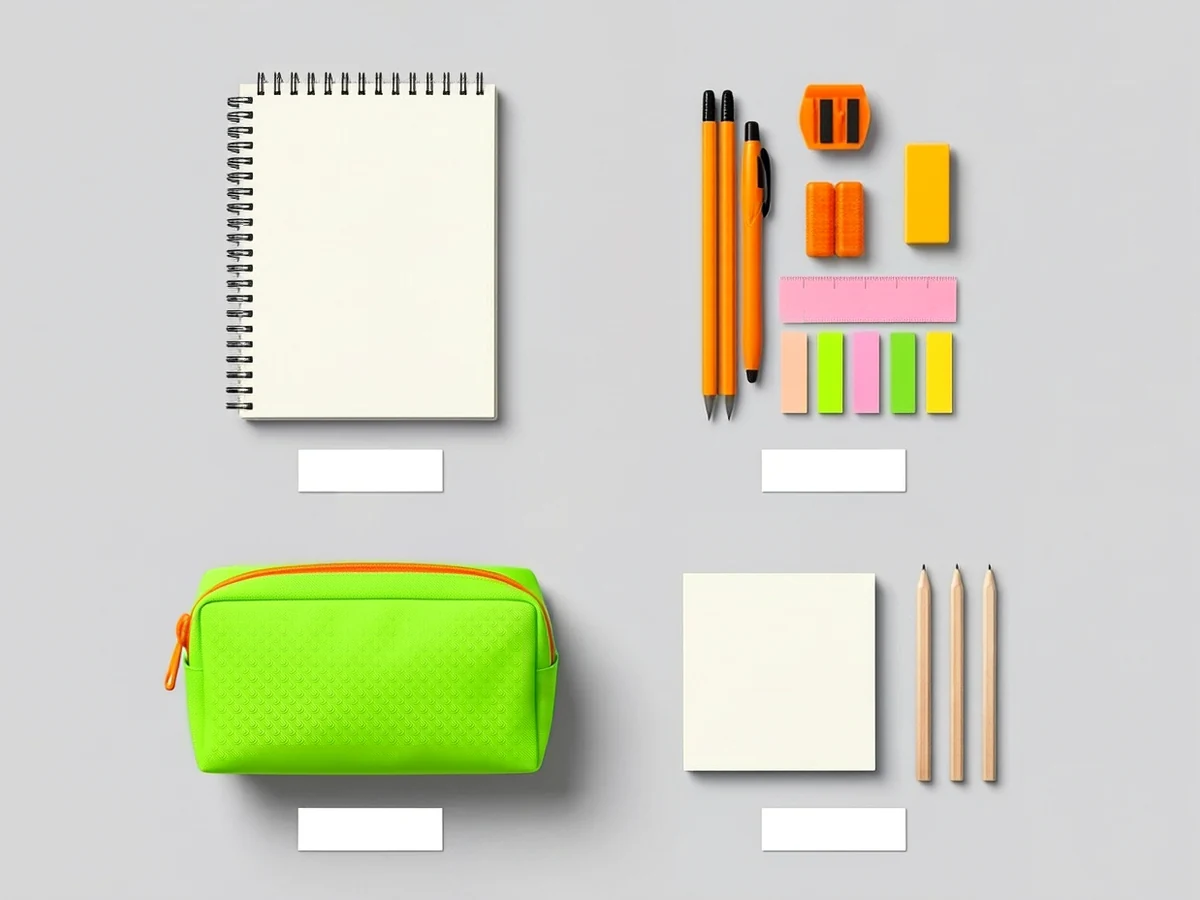
Class or grade packs. A pack per grade built from the school list — books, files, covers, pencils, glue — banded or boxed with a contents label. These are assembled, so the packing time, the contents list and the pack artwork all need approving before production starts. Carton and pallet configuration should be planned together with the pack, not after it.
Packaging is developed with the product rather than added at the end, because the display unit width and the carton count both feed back into the price.
8. Quantities, MOQ and the quotation
- Stock products: from one carton, depending on the item.
- Custom school stationery on suitable products: from 500 pieces per design.
- Final figures: confirmed in the quotation against product, material, colour, process, tooling, packaging and quantity.
The quotation is where the real minimum is settled. A page-count change, a new ruling, a laminated cover or a custom class-pack label each move the number. The MOQ guide explains how stock, standard and custom thresholds differ.
For a school range, the most useful commercial exercise is to compare options at the same retail price point — 72 pages on 80 GSM with a laminated cover against 64 pages on 90 GSM with a plain cover — and to state explicitly what each option gives up. Mixed-SKU orders can consolidate freight, but only when the carton and pallet plan is designed with the order.
9. Documents schools and buyers ask for
Requirements follow the product, the user age and the destination market, and the documents must match the actual factory, product and order.
- Inspection: AQL 2.5 sampling to ISO 2859-1, against the approved sample and the agreed specification.
- Factory assessments: we coordinate amfori BSCI, SMETA (Sedex), FCCA and SCAN assessments for the selected production site.
- Material claims: FSC-certified sourcing options are available on suitable products, and EUDR-related traceability documentation is supported for the products and orders in scope.
- Product testing: EN 71 for children’s items, BS 7272 for writing instruments, ASTM F963, REACH and other standards as applicable to the product and market.
- Project authorisation: Disney FAMA authorisation support where a licensed programme requires it.
Available documents depend on the selected factory, product and order, so raise the requirement at brief stage. The supplier audit and compliance guide explains how to check the scope of an audit report rather than the logo on the cover.
10. Brief template and next step
A brief that answers these questions gets a usable quotation:
| Item | What to state |
|---|---|
| Products | Exercise books, quad books, counter books, files, pencil cases, packs |
| Format | Trim size and page count matrix (e.g. 32 / 72 / 192) |
| Paper | Interior GSM and shade, cover GSM |
| Ruling | Feint and margin, quad and margin, margin width |
| Binding | Saddle stitch, perfect bound, wire-o, sewn hard cover |
| Cover | Material, lamination, name panel, ruling print |
| Packing | Single unit, class pack, display unit, carton and pallet counts |
| Quantity | Per design, and whether mixed SKUs are planned |
| Commercial | Target retail price, destination port, required shelf date |
Working with Shiny You on a South African school range
Our founder, Janey Liu, entered the stationery industry in 1999, and the team now works from a Ningbo showroom holding 100+ curated collections across stationery, arts and crafts, bags and gifts. Through importers and project partners we have supported Walmart and Disney projects, and our wider retail programme experience includes Lidl, Poundland, WH Smith, Ryman, ASDA, Action and Home Bargains — 100+ brand customer projects in total.
Production combines our own manufacturing capability with selected partners in China, Malaysia, Thailand, Vietnam and Cambodia, chosen per project against product, quantity, quality requirement and schedule. Trade terms are FOB Ningbo or Shanghai, EXW or CIF, confirmed per order.
Next step: send your school list or page-count matrix, target quantities and the date the goods must be on shelf, and we will confirm formats, packing and lead-time options for your market.
Request a school stationery quote · Browse school stationery · Catalog and sample requests: vip1@shinyyoustationery.com
FAQ
When should a South African school stationery order be placed?
Work back from the January term start and the December list issue. For a full-custom range, specification and samples are usually confirmed by August and the production order placed by September, so goods are complete before the Chinese New Year slowdown and the pre-Christmas freight peak. Sampling runs from 24 hours to 14 days and production approximately 10–45 days, confirmed per project.
What is the minimum order for school exercise books?
Stock formats can start from one carton per product. Custom school stationery on suitable products starts from 500 pieces per design, with the final figure confirmed in the quotation against product, material, colour, process, tooling, packaging and quantity.
Can one order cover several page counts in the same cover design?
Yes, where the product and packing allow it. A 32 / 72 / 192-page matrix in one cover artwork is a common school request; the combination is planned at production and carton level and confirmed with the quotation.
Can you supply class packs built from a school list?
Yes. Class or grade packs can be assembled from books, files, covers and writing items against a supplied list, with contents labels and pack artwork approved before production.
Can you provide FSC paper and audit documents?
We offer FSC-certified sourcing options on suitable products and coordinate BSCI, SMETA, FCCA and SCAN assessments. Available documents depend on the selected factory, product and order, so the requirement is checked for your specific project.