

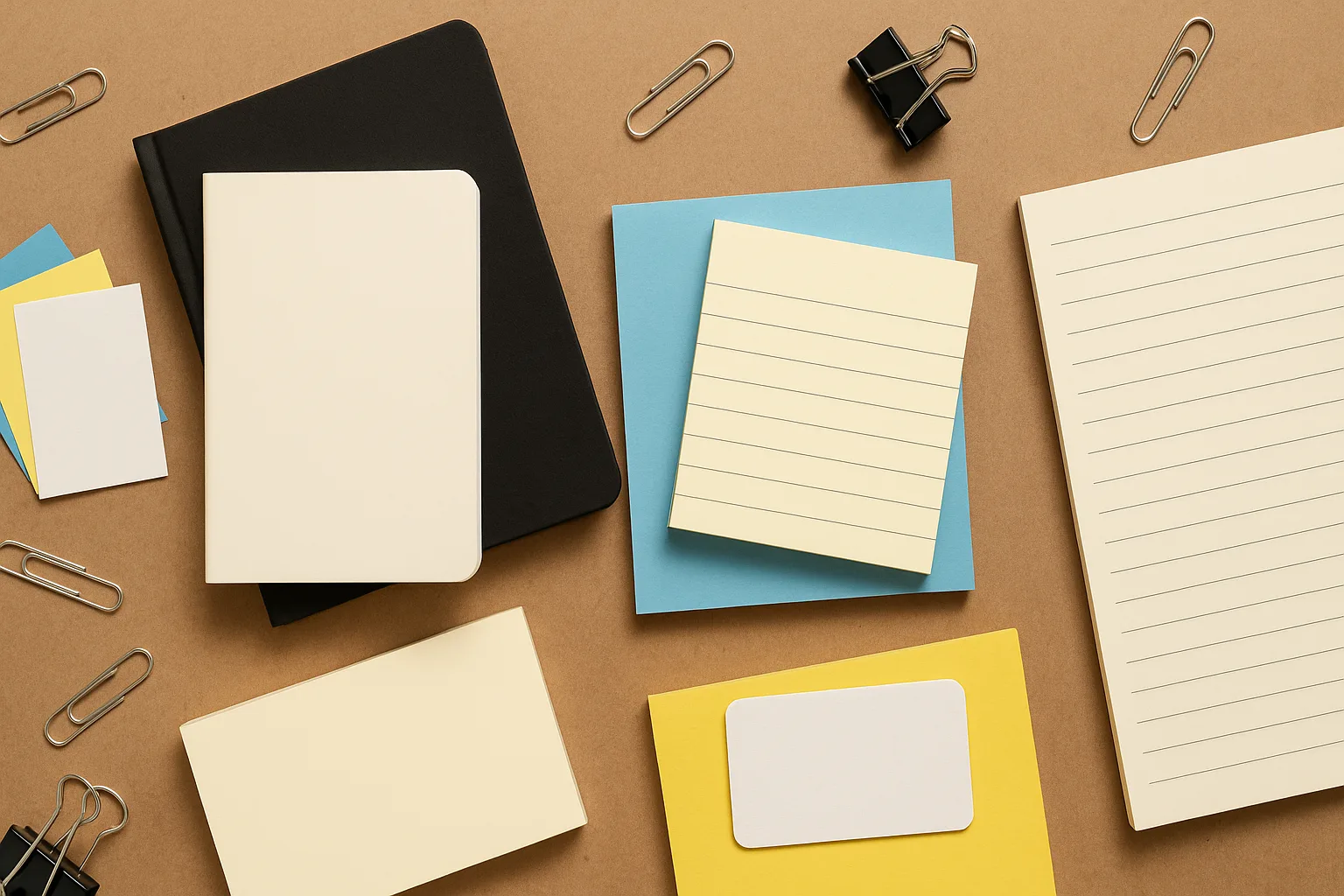
Guía definitiva sobre el gramaje y el grosor del papel: Cómo elegir el papel adecuado para cada uso
En Papelería Shiny You, quality is in the details. For nearly 20 years, we’ve been producing stationery that doesn’t just look good — it feels right. One of the most important details that often gets overlooked is paper weight. Whether for notebooks, printer paper, index cards, or planners, selecting the proper paper weight affects not only the tactile experience, but also printing quality, durability, cost, and even environmental footprint.
In this guide, we’ll explain everything you need to know about paper weight: what it means, how to read charts, how different paper weights are used in our product lines, and how to choose what’s right for your private label or bulk stationery order from Shiny You.

1. What Is Paper Weight / Paper Thickness
“Paper weight” refers to how heavy or thick a sheet of paper is. It is often connected with the phrase “how substantial “ or “premium” something feels. Thickness also influences how well ink holds up, whether there is show‐through (ink bleeding to the back), how durable the paper is to bending or folding, and how nicely product edges stay crisp.
Important points:
Two papers with the same weight (by GSM or lbs) may feel different if one is coated (glossy, matte) and the other uncoated.
Texture, finish, fiber content, and how the paper is calendered/compressed all influence the feel and appearance.
2. Common Measurement Systems
Here are the main units you’ll see:
| Measurement | Abbreviation / Name | What It Means / Where Used |
|---|---|---|
| GSM (grams per square meter) | GSM or g/m² | The international, metric standard. Tells how many grams a 1 m × 1 m sheet weighs. Used globally, especially outside USA. |
| Basis Weight (lbs) | lbs or “#” (Text / Cover / Bond etc.) | Common in USA / North America. The weight of a “ream” (500 sheets) of a standard size for that paper type. Note: “80 lbs cover” is not same thickness as “80 lbs text”. |
| Points (pt) | pt | Usually for cover stock / cardstock. 1 pt = 0.001 inch of thickness. Gives a sense of thickness / rigidity. |
| Caliper / mil / mm | mm or mil (thousandths of an inch) | Direct physical thickness measurement. Useful especially when determining how the paper will handle folding, binding, mailing, etc. |
3. Shiny You’s Stationery Products & Their Typical Paper Weights
Here at Shiny You, we offer a wide variety of paper products. Below are some product categories and the typical paper weights we use — either standard, or in customizable options. This gives you a reference when placing custom orders or designing your own line.
| Product Type | Common Paper Finish / Type | Typical GSM / Basis Weight (Custom Options) |
|---|---|---|
| Printer Paper (office / school use) | Uncoated, smooth finish | 70–100 GSM (≈ 18–24 lb bond) |
| Notebooks (softcover) | Uncoated or lightly coated, lined, dotted, grid | 80–120 GSM (≈ 21–32 lb text) |
| Notebooks (hardcover) | Thicker board covers + interior pages | Covers ~250–300 GSM; interior ~100 GSM |
| Sticky Notes & Revision Cards | Lightweight, uncoated | 70–90 GSM |
| Index Cards / Flashcards / Tags | Heavier cardstock, uncoated or semi coated | 250–350 GSM or cover weight equivalents (e.g. 10-14 pt) |
| Planner Pads & Desk Pads | Smooth / lightly coated to reduce bleed through | 120-150 GSM |
| Sobres | Uncoated, may be thicker at flap or crease | 90-120 GSM or specialty (depending on size) |
Note: For custom orders via Papelería Shiny You, we can adjust within broader ranges; if you need lighter or heavier, we can usually source or manufacture accordingly.
4. Paper Weight Conversion Chart
Here’s a chart to help you compare paper weights across different measurement systems. This will help you understand the equivalents when you see “GSM”, “lbs”, “pt”, etc.
| Example Use / Type | Approximate GSM | Approximate Basis Weight (USA, Text or Cover) | Approximate pt / Thickness* |
|---|---|---|---|
| Everyday Printer & Copy Paper | 70 – 90 GSM | ~18 – 24 lb bond/text | ~0.10 – 0.14 mm |
| Medium Notebooks or Softcover Journals | 100 – 120 GSM | ~28 – 32 lb text | ~0.14 – 0.17 mm |
| Heavier Notebook/Planner Interior with Light Coating | 120 – 150 GSM | ~32 – 40 lb text | ~0.17 – 0.20 mm |
| Cover Page or Thick Notebook Cover | 200 – 300 GSM | ~55 – 90 lb cover | ~0.25 – 0.40 mm |
| Index Card / Tag / Business Card Thickness | 300 – 350 GSM | ~100 – 120 lb cover | ~0.40 – 0.50 mm |
* Thickness estimates are approximations. Finish, coating, fiber content all cause variation.
5. How Paper Weight Affects Product Use: Which Weight for Which Product
Here are specific recommendations based on how the paper is used. When designing or ordering stationery, think about the purpose, handling, and printing method.
| Producto | Key Requirements | Recommended Weight Range | Why This Matters |
|---|---|---|---|
| Notebooks / Journals | Writeability, low bleed through, durability | Interior: 80–120 GSM; Covers: 200–300 GSM | Too light → show-through, flimsy; too heavy → bulk & cost increase |
| Notas adhesivas y blocs de notas | Affordable, easy tear-off, minimal warping | 70-90 GSM | Lower costs; lighter feel; tearability |
| Business Cards / Tags / Index Cards | Stiffness, clean cut edges, glance impression | 250-350 GSM or ~12-16 pt cover equivalent | Must feel premium in hand; employ thick cover stock |
| Sobres | Foldability, strength at flap/edge, light handling | 90-120 GSM or specialty envelopes with reinforcement | Thin → tear; thick → poor folding, increased shipping cost |
| Planner Pads / Desk Pads | Frequent use, repeated writing, durability | 120-150 GSM interior; heavier backing / base | Thicker paper resists denting, warping; smoother finishes help pen performance |
| Printer / School Copy Paper | Low cost, acceptable printing, everyday use | 70-100 GSM | Balanced weight; many printers handle up to ~100 GSM easily; beyond that need special handling |
6. Trade-offs: Cost, Printing, Durability, Feel
Choosing paper is always balancing advantages & disadvantages. Here are what to watch out for:
Cost: Heavier papers cost more — more raw material, more shipping weight. So when you spec 300 GSM covers, expect higher per-unit cost and freight.
Printing Compatibility: Not all printers (especially home / small desktop printers) can handle heavy or thick stocks. Some products require coil binding, saddle-stitch, perfect binding — heavy paper influences binding method.
Ink Behaviour & Coating: Coated papers (gloss/matte/silk) reduce bleeding, improve image sharpness, but cost more and sometimes more slippery surface. Uncoated is more natural, easier to write on.
Perceived Quality & Brand Image: Thicker, premium stock gives impression of “high end”; useful if you target premium stationery lines, gift sets, etc.
Bulk, Weight, Shipping Cost: Heavier paper means heavier package; if shipping internationally or bulk, this adds up.
Impacto medioambiental: Using very heavy paper unnecessarily increases resource usage & carbon footprint. Also, recycled content can affect the weight & feel, and sometimes the whiteness or brightness.
7. Practical Tips When Ordering Bulk Stationery or Custom Products via Shiny You
As a manufacturer, here are things we recommend to ensure you get what you expect:
Request Physical Samples
Even with charts, seeing & feeling paper matters. Shiny You can provide sample swatches of common stocks in your desired weight / finish.Specify All Details
When ordering, tell us: GSM (or lbs), finish (coated/uncoated), texture, color brightness, whether both sides will be printed, whether lamination / UV / other finishing.Plan for Weight vs. Bulk
If you are designing a notebook with many interior pages and thick cover, size can get bulky. Think about spine strength, binding method, packaging size.Check Printer / User Use
If your customer will write or draw on it, avoid heavily coated glossy finishes. For pens, fountain pens: thicker uncoated stock tends to feel better.Balance Cost & Perception
If your products are marketed as premium gifts or corporate gifts, heavier paper is part of perceived value. For school / low cost lines, lighter paper may suffice.Sustainability Options
If you care about eco-friendly, recycled, or FSC / PEFC certified, discuss with us how that affects weight & finish. Often recycled papers have slightly different feel / color / opacity.
8. Summary Recommendations
If you’re not sure where to begin, here are typical “safe” paper weight choices for Shiny You stationery private label or wholesale lines:
Standard notebook interior: 100 GSM, uncoated
Notebook cover (hardcover): 250–300 GSM, possibly coated or with protective lamination
Business cards / Tags: 300–350 GSM (approx. 12-16 pt)
Index / Flash cards: 280-320 GSM
Sticky Notes: ~80 GSM for the writing part; back pad heavier or reinforced
These provide a good balance of usability, cost, and premium feel.
9. FAQ
Q1: What’s the difference between GSM and lbs?
A: GSM (grams per square meter) is a universal metric measurement. Lbs (“basis weight”) depends on the paper type and the size of the ream. So “80 lbs cover” is not directly equivalent to “80 lbs text.” Always check what the basis is.
Q2: If I increase paper weight for my notebook, how much will cost go up?
A: It depends on the jump. Moving from 100 GSM to 200 GSM can double the paper cost for interior pages (depending on finish) plus increase shipping. But the perceived value may also rise.
Q3: Can thick paper cause printing problems or delivery issues?
A: Yes. Thick stock may jam some printers, may be harder to bind, may increase shipping dimensions & weight. Also, folding/creasing thick stock requires special handling to avoid cracking coatings.
Q4: Are coated papers always better for images?
A: Coated papers help with sharper, more vibrant images & reduce bleed-through. But they may be more slippery for writing, more expensive, and they reflect light more. For mixed writing & image use, a silk or matte coating is often a good compromise.
Q5: Is there a standard “premium” paper weight that signals quality without going overboard?
A: Many brands find that 200-300 GSM for covers + 100-120 GSM for interiors gives a strong premium feel without becoming too costly or bulky.
Q6: How to choose paper weight for custom printer paper orders?
A: Think about the primary use: document printing vs promotional printing vs retail use. Then check how likely bleed, show-through, folding, or mailing is. Match weight accordingly. Also consider the printer’s capacity.
Shiny You Paper Weight Suggestion Table
Below is a proprietary Shiny You suggestion table to help you quickly pick suitable paper weights for various stationery products.
| Producto | Minimum Recommended GSM / pt | Premium / Upgraded Option | Key Notes |
|---|---|---|---|
| Softcover Notebook Interior | 80 GSM (~0.14 mm) | 120 GSM | Upgrading improves feel, reduces ink show-through |
| Hard Cover Notebook Cover | 250 GSM (~12-14 pt) | 300 GSM + Lamination or Emboss | Heavier cover improves durability & perception |
| Sticky Notes Writing Sheet | 80 GSM | 100 GSM | Higher GSM helps reduce tearing or curling |
| Index / Flash Cards | 300 GSM (~12-14 pt) | 350 GSM | For durability, thicker edge & stiffness |
| Planner Pads / Desk Pads | 120-150 GSM | 180 GSM / Heavy Base Board | Ensures the pad lays flat, resists bend |
| Business / Gift Cards | 300-350 GSM (~14-16 pt) | 400 GSM+ or Specialty Cardstock | Heavier stock gives prestige; consider rounded corners, coating |
Why Shiny You’s Chart & Process Helps You
At Shiny You Stationery, we don’t just work by the numbers — we test and feel. Over our years supplying clients worldwide, we’ve learned:
Clients often undervalue how much paper weight influences perception: even slight upgrades (from soft 80 GSM to 100+ GSM interiors, or from 250 to 300 GSM covers) are noticed.
Printing tests (one side vs both sides, saturated vs light inks) are essential. A 120 GSM light paper might look acceptable for text, but if printing full color graphics on both sides, might need heavier weight or special coating.
Finish (coated/uncoated), grain direction (for binding), and even moisture/humidity in transit affect how weight and thickness feel.
Conclusión
Choosing the right paper weight is one of the core decisions in designing stationery. It influences cost, usability, durability, printing quality, and brand perception. At Papelería Shiny You, we aim to guide you through this complexity so that your final product delights both you and your customers.
If you’re planning a custom stationery line, bulk notebooks, or just want to upgrade your existing products, use the charts here, request swatches, talk with our team about what you envision—and we’ll help you match paper weight, finish, and feel to your goals.
When you select stationery from us (or when you pick paper elsewhere), think about:
What writing tools/media you’ll use (pen, marker, fountain pen, paint, etc.)
How often you’ll use it, and whether you want durability vs portability
The feel you want—a thin whisper, mid-weight comfort, or a solid luxurious heft
If you ever need guidance, Shiny You is happy to help advise on which GSM / thickness will best suit your needs.
Contact us at Papelería Shiny You anytime for samples, quotes, or advice. Let’s make stationery that writes well, feels premium, and makes a statement.