


Planner Quality Control: How We Test Layout Alignment, Margins & Specialty Features
Planner Quality Control: How We Test Layout Alignment, Margins & Specialty Features
A planner that photographs perfectly can still fail in a customer’s hands — quality control is what catches the difference before it ships.
China’s wholesale planner manufacturers ship millions of units a year across formats — spiral, hardcover, disc-bound — and at that volume, a flaw invisible on one unit becomes a batch-wide problem fast. Planner quality control is the structured inspection process that catches layout, margin, binding, and finishing defects before a run reaches mass production, not after it lands on a retailer’s shelf.
This guide breaks down exactly what gets inspected at each stage of planner production, and what buyers should be asking their manufacturer to check before approving a run.
Table of Contents
- Why Planner Quality Control Runs in Stages
- Layout Alignment Testing
- Margin Accuracy Testing
- Page Consistency Inspection
- Binding and Spine Testing
- Specialty Feature Testing
- Printing Precision Verification
- Functional Usability Testing
- Final Quality Audit Before Shipment
- Common Planner Quality Issues to Watch For
- Start Your Planner Sourcing with Shiny You
1. Why Planner Quality Control Runs in Stages

Layout. Margins. Binding. Finish. Four checkpoints, one goal — nothing reaches a customer that wasn’t caught first.
Layout. Margins. Binding. Finish. Four checkpoints, one goal — nothing reaches a customer that wasn’t caught first.
Planner quality control exists because defects compound at volume. A single misaligned page is a minor flaw; the same flaw repeated across a 5,000-unit run is a batch-wide failure.
Pre-production sampling. Layout, margin, and binding specs are verified against a physical proof before the full run starts — not after it’s already printed.
In-line checks. Spot inspections run throughout the production line, not only at the start and end of a batch.
Pre-shipment inspection. A final sample pull checks the completed run against the original specification before the order is approved to ship.
Catching issues at the earliest possible stage is what keeps a full production run from failing inspection after the fact.
2. Layout Alignment Testing
Layout alignment testing confirms that every printed element — date grids, headers, rule lines, icons — lands exactly where the design file specifies, on every page, in every unit.
- Text positioning — printed placement checked against the source file, page by page
- Visual symmetry — spacing and alignment compared across facing pages
- Cross-page consistency — spot checks throughout the book, not only the first and last page
Printed samples are pulled and compared directly against the digital proof before a production run is approved.
3. Margin Accuracy Testing
Margin accuracy testing determines whether a planner is comfortable to write in and safe to bind. Inspectors check:
- Top, bottom, inner, and outer margin measurements against spec
- Binding-safe gutter zones, so content isn’t lost into the spine
- Trim size accuracy against the standard paper size (A5, A4, or custom) the order is built on
Margin drift toward the gutter is one of the most common defects in tightly bound formats, which is why it’s checked before binding, not after.
4. Page Consistency Inspection
Page consistency inspection ensures a planner reads as one unified product from cover to cover, not a stack of individually printed sheets.
- Page size uniformity across the entire book
- Typography consistency — weight, size, and spacing
- Color and paper weight consistency from the first page to the last
Consistency issues are easy to miss on a single page and obvious the moment one page breaks the pattern.
5. Binding and Spine Testing
Binding and spine testing is where most planner returns originate, so it’s tested under real handling stress, not just visual inspection. This applies across spiral, hardcover, softcover, and disc-bound formats.
Flex testing. Spiral and disc bindings are opened and closed repeatedly to simulate a year of daily use — any wire loosening or coil deformation fails the sample.
Page adhesion. Perfect-bound and hardcover spines are checked for how securely pages hold under repeated use.
Lay-flat performance. Checked at the front, middle, and back of the book — a planner that won’t lay flat in the middle section is a common defect specific to perfect-bound formats.
6. Specialty Feature Testing
Specialty features are where planners differentiate — and where quality issues are most visible to the end user. Each of the following is tested individually for adhesion, durability, and finish:
- Tabs and dividers
- Stickers and inserts
- Pockets and folders
- Elastic closures
- Foil stamping and embossing
A tab that lifts after light use, or foil detailing that flakes on first touch, is a defect even if the rest of the unit is flawless — so these features are held to the same standard as the core printing.
7. Printing Precision Verification
Printing precision verification checks color consistency across the full run, ink density, line clarity, and registration accuracy — how precisely different ink layers align. This is what prevents color drift between the first unit off the press and the last.
8. Functional Usability Testing
Before a sample is approved, it’s used the way a customer actually would.
- Writing surface — checked for smoothness and consistency across page types (grid, lined, blank)
- Bleed-through resistance — tested against standard pen and marker types
- Page-turning smoothness — verified across the full book, not just the opening pages
- Feature accessibility — tabs, pockets, and closures tested for ease of use in normal handling
A planner that passes every visual check can still fail here, which is why usability is tested as a separate stage.
9. Final Quality Audit Before Shipment
The last stage before shipment covers random sample inspection, defect rate evaluation against agreed thresholds, packaging condition, and carton labeling. Only batches that clear every prior stage reach this audit — and only units that pass it are approved for delivery.
According to the International Organization for Standardization, sampling-based inspection is the standard approach used across the printing and paper goods industry for verifying batch quality without inspecting every single unit.
10. Common Planner Quality Issues to Watch For
- Gutter margin creep — content pushed toward the binding on tightly bound formats
- Wire or coil deformation — spiral bindings that loosen before the expected use cycle
- Color drift — visible variance between the first and last units off a print run
- Foil and tab lift — specialty features that pass visual inspection but fail adhesion under use
- Uneven paper weight — stock that falls below spec, causing bleed-through in daily use
Catching these during pre-production sampling — not after mass production — is what separates a reliable manufacturing partner from one that ships problems downstream.
11. Start Your Planner Sourcing with Shiny You
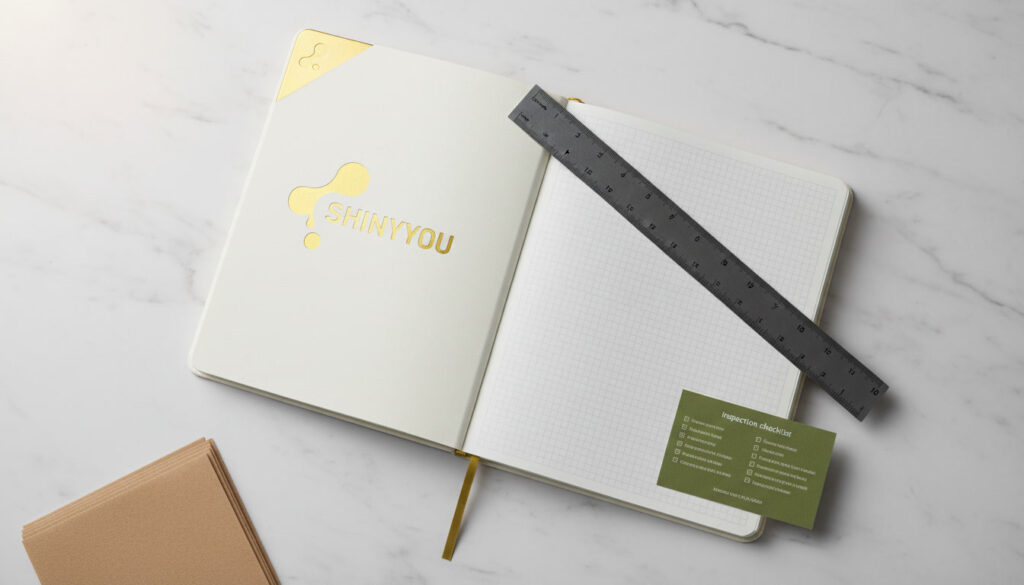
20 years. 7 certifications. 30+ countries. One quality control process behind every planner we ship.
20 years. 7 certifications. 30+ countries. One quality control process behind every planner we ship.
Shiny You Stationery is a direct manufacturer based in Ningbo, China — China’s stationery capital — with nearly 20 years of experience producing planners and notebooks for wholesale buyers across 30+ countries.
- Direct manufacturer — our factory in Ningbo is open for visits, physical or virtual, at any time
- Full certification portfolio — FSC, BSCI, EUDR, FDA, Walmart FCCA, SCAN, Disney — all current and verified
- Standard MOQ: 3,000 pieces — with production run entry from 5 cases when existing orders are running
- Full OEM capability — cover design, binding type, and specialty feature customization from 3,000 pieces
- English-speaking account management — direct communication, no intermediaries
- Quote within 24 hours — send your specifications and we respond the same business day
Browse our planner and notebook range or contact our team at shinyyoustationery.com to start your planner quality control conversation today.
Planner quality control works when it’s built into every stage of production, not bolted on at the end. Shiny You has spent nearly 20 years building the inspection process, certification portfolio, and manufacturing capability to back that up. Start here. Source smart.