

10 Questions to Ask Before Choosing a Stationery Manufacturer
10 Questions to Ask a Stationery Manufacturer Before You Buy in 2026
Most buyers choose a stationery manufacturer on price alone. These 10 questions reveal everything price never shows you.
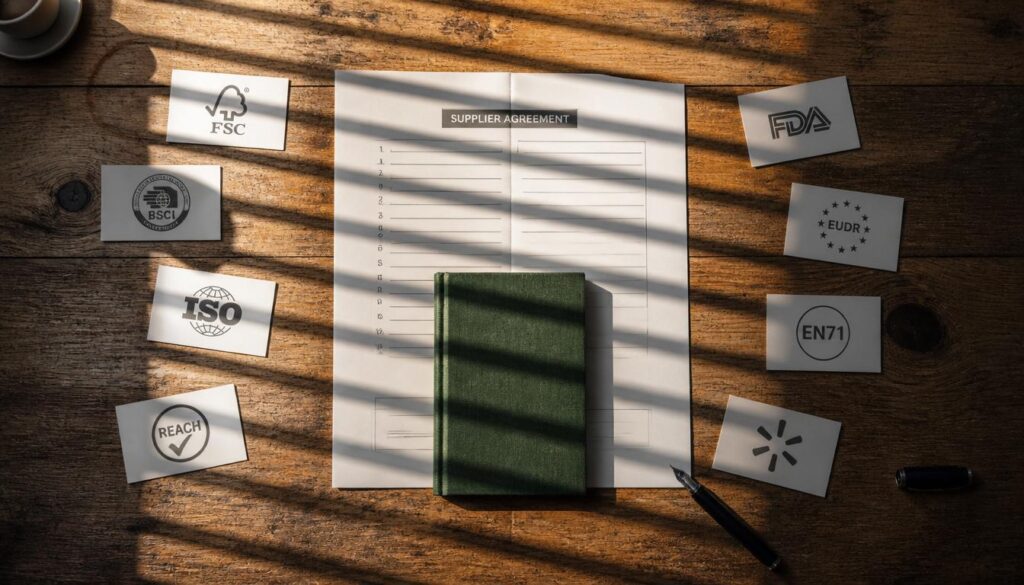
Vetting a supplier starts with the right questions, not the lowest quote
Choosing the right stationery manufacturer is one of the most consequential sourcing decisions a wholesale buyer, retailer, or corporate procurement team makes. The wrong choice costs you money, time, market credibility, and in some cases regulatory compliance.
The right one becomes the foundation of a supply relationship that grows with your business for years. Yet most buyers approach manufacturer selection without a structured evaluation framework — relying on price quotes, catalogue browsing, and gut feeling instead of a clear list of questions to ask a stationery manufacturer.
This guide gives you the 10 essential questions to ask a stationery manufacturer before committing to any supplier — and what the answers should look like.
Table of Contents
- Why Manufacturer Selection Matters More Than Ever in 2026
- Question 1 — Are You a Manufacturer or a Trading Company?
- Question 2 — What Certifications Do You Hold?
- Question 3 — What Is Your Minimum Order Quantity?
- Question 4 — Can You Show Me Your Factory?
- Question 5 — What Are Your OEM Capabilities?
- Question 6 — What Are Your Lead Times?
- Question 7 — How Do You Handle Quality Control?
- Question 8 — Can I See References From Existing Buyers?
- Question 9 — What Are Your Payment Terms?
- Question 10 — What Happens If Something Goes Wrong?
- How Shiny You Answers Every Question
1. Why Manufacturer Selection Matters More Than Ever in 2026
The wrong stationery manufacturer and the right one can look identical in a catalogue. They never look identical after the first order.
The global stationery market is projected to reach USD 120 billion by 2033. Competition among wholesale buyers for shelf space, corporate contracts, and institutional supply agreements has never been more intense.
In this environment, your stationery manufacturer is not just a vendor — it is a strategic partner whose capabilities, certifications, and reliability directly determine your ability to compete. Knowing which questions to ask a stationery manufacturer before you sign anything is what separates buyers who scale smoothly from buyers who spend a year firefighting.
In 2026 specifically, three factors make manufacturer selection more consequential than in previous years:
Compliance requirements are stricter. EUDR, REACH, and BSCI requirements have raised the baseline compliance bar significantly. A stationery manufacturer without current, verified certifications cannot supply EU or major US retail channels.
That means a poor selection decision creates regulatory exposure that affects your entire business. This is exactly why compliance sits near the top of any serious list of questions to ask a stationery manufacturer.
Customization demand is higher. The rise of branded corporate gifting, private label retail, and OEM stationery sets means buyers increasingly need a stationery manufacturer who can deliver bespoke products, not just catalogue items. Manufacturers without genuine OEM capability cannot serve this growing market segment, which is why OEM capability is one of the non-negotiable questions to ask a stationery manufacturer.
Supply chain visibility matters. Post-pandemic sourcing has made supply chain transparency a buyer priority. A stationery manufacturer who cannot demonstrate production traceability, material sourcing documentation, and quality control processes is a liability in 2026 — and traceability should be near the top of your questions to ask a stationery manufacturer before you sign anything.
2. Question 1 — Are You a Manufacturer or a Trading Company?
This is the first of the essential questions to ask a stationery manufacturer — and the one most commonly glossed over in the rush to get a price quote. Among all the questions to ask a stationery manufacturer, this one sets up every answer that follows.
The distinction matters enormously, and it’s the reason this sits first on any list of questions to ask a stationery manufacturer. A genuine stationery manufacturer owns or operates the production facility, controls the manufacturing process directly, and can customize products, manage quality at source, and provide verifiable factory certifications.
A trading company sources products from third-party factories and acts as an intermediary — adding a layer of markup and removing your ability to verify production conditions, quality control, or certification authenticity directly.
Here’s what separates a real answer to this one of the questions to ask a stationery manufacturer from a rehearsed one — what a genuine stationery manufacturer can provide that a trading company cannot:
- Factory audit access — you can visit and inspect the actual production facility
- Direct certification verification — BSCI, FSC, ISO 9001 certificates tied to the actual factory
- Production customization — genuine OEM capability at the manufacturing level
- Quality control at source — issues identified and resolved in production, not after shipment
- Factory-direct pricing — no trading company markup on every order
How to verify: Request the factory’s business license, BSCI audit report, and ISO 9001 certificate. All three should show the same legal entity name and address as the facility you are dealing with.
Any discrepancy is a signal that you may be dealing with a trading company rather than a direct stationery manufacturer — which is exactly what this first of the questions to ask a stationery manufacturer is designed to catch.
3. Question 2 — What Certifications Do You Hold?
The certifications a stationery manufacturer holds determine which markets you can sell into and which retail channels you can access. This is not a compliance formality — it is a commercial prerequisite, and one of the most important questions to ask a stationery manufacturer before you even discuss price.
The minimum certification standard for a credible stationery manufacturer in 2026 — and a good starting point for your own questions to ask a stationery manufacturer checklist:
- FSC — mandatory for paper products entering EU and major global retail
- BSCI — required by most European retail chains and institutional buyers
- EUDR — mandatory for paper products entering EU markets from 2025
- REACH — chemical compliance for EU market access
- EN71 — required for children’s stationery in EU markets
- FDA — US market compliance for writing instruments and art supplies
Premium stationery manufacturers will additionally hold Walmart FCCA, Disney ILS compliance, and SCAN certification — opening access to major retail chains and licensed product distribution. Asking about these upfront is one of the more advanced questions to ask a stationery manufacturer targeting premium retail channels.
How to verify: Request original certificate documents, not website logos. Verify FSC certificates directly at search.fsc.org.
For BSCI, verify audit status through the amfori platform. Check expiry dates. Confirm the certification scope covers the specific products you are sourcing. Never accept self-declarations as a substitute for third-party verified certifications — this is one of the questions to ask a stationery manufacturer where a vague answer should end the conversation.
4. Question 3 — What Is Your Minimum Order Quantity?
MOQ is one of the most practically significant commercial terms in any stationery manufacturer relationship — particularly for buyers placing first orders, testing new products, or managing tight inventory budgets. It’s also one of the most concrete questions to ask a stationery manufacturer, since the answer is a number, not a promise.
Standard MOQs vary significantly across different types of stationery manufacturers, and getting a straight answer here is one of the clearest questions to ask a stationery manufacturer to gauge how transparent they’ll be about everything else:
- Large-scale manufacturers — typically 2,000 to 5,000 units per SKU for standard products, 5,000+ for full OEM custom products
- Mid-size manufacturers — typically 500 to 2,000 units for standard products, 1,000 to 3,000 for OEM
- Flexible manufacturers — offer production run participation from as low as 5 cases, allowing buyers to tag onto existing runs at minimal volume commitment
For first-time buyers, the ability to start small — test the product, verify quality, and build the relationship before committing to large volumes — is commercially critical.
A stationery manufacturer who insists on large MOQs for first orders without flexibility is asking you to take all the risk while they take none, which is worth surfacing early among your questions to ask a stationery manufacturer.
The most commercially intelligent approach is to find a stationery manufacturer who offers both flexibility for new buyers and scale for established relationships — adjusting MOQ requirements as the relationship develops and order history builds. MOQ flexibility belongs near the top of your questions to ask a stationery manufacturer list, especially if this is your first order.
5. Question 4 — Can You Show Me Your Factory?
A credible stationery manufacturer will always welcome factory visits — physical or virtual. This is one of the simplest questions to ask a stationery manufacturer to test, and it is not really about logistics. It is a trust test.
A manufacturer who hesitates, deflects, or makes excuses when asked to show their factory is giving you critical information.
Either the facility does not exist as described, the production conditions do not meet the standards implied, or you are dealing with a trading company rather than a direct manufacturer — all things this one of the questions to ask a stationery manufacturer is built to expose.
What to look for in a factory visit — this is where the questions to ask a stationery manufacturer turn into things you can actually verify with your own eyes:
- Scale — does the facility match the production capacity claimed?
- Cleanliness and organization — a well-run factory reflects well-run production processes
- Quality control stations — are there systematic inspection points in the production line?
- Worker conditions — are BSCI social compliance standards visibly in practice?
- Machinery and equipment — is the facility capable of producing the products at the quality level claimed?
- Certification displays — are FSC, ISO 9001, and other certificates visibly posted in the facility?
If a physical visit is not possible, request a live video factory tour. A reputable stationery manufacturer will accommodate this without hesitation — it is standard practice for serious B2B relationships in 2026, and one of the easiest questions to ask a stationery manufacturer to act on immediately.
6. Question 5 — What Are Your OEM Capabilities?
OEM capability is the distance between raw materials and a finished branded product. The right stationery manufacturer closes that gap completely.
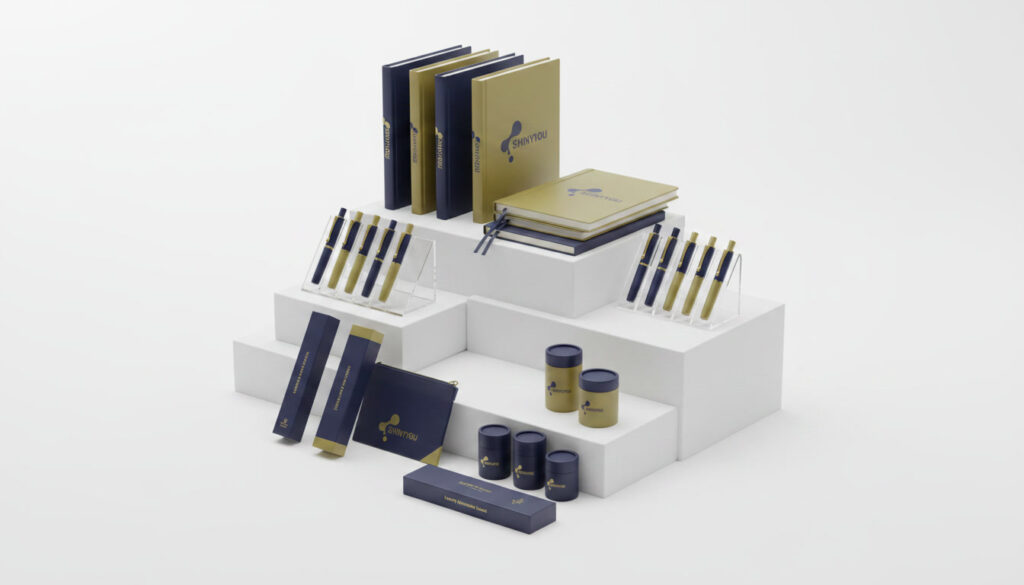
Genuine OEM capability means custom covers, branding, and packaging, not just a catalogue
OEM capability — the ability to produce custom-branded products to your specifications — is one of the most commercially valuable services a stationery manufacturer can offer.
In 2026, the demand for branded stationery sets, private label products, and bespoke corporate gifting ranges has made OEM capability a baseline expectation rather than a premium service, and one of the questions to ask a stationery manufacturer that separates serious factories from the rest.
What genuine OEM capability looks like:
- Custom cover design and print — including foil stamping, embossing, and soft-touch lamination
- Custom paper weight and ruling specification — choosing exactly the paper quality your customers expect
- Custom pen barrel colors and branding — Pantone-matched barrel colors with logo printing or engraving
- Custom packaging design — rigid gift boxes, branded retail packaging, custom carton printing
- Custom product bundling — combining multiple products into a bespoke branded set
Questions to drill deeper on OEM: What is the minimum quantity for OEM customization? Do you hold tooling for foil stamping in-house or outsource it? Can you provide pre-production proofs before mass production? What is the typical lead time for a fully custom OEM product?
A stationery manufacturer with genuine OEM capability will answer all of these questions confidently and specifically. Vague answers — “yes we can do custom” without details — should prompt further investigation before you commit. OEM depth is one of the questions to ask a stationery manufacturer that separates a real production partner from a reseller with a catalogue.
7. Question 6 — What Are Your Lead Times?
Lead time accuracy is the single most commercially consequential piece of information a stationery manufacturer provides — and the one most frequently misrepresented, misunderstood, or miscommunicated. It’s also one of the more revealing questions to ask a stationery manufacturer, since vague answers here almost always predict missed deadlines later.
Standard lead times to expect from a credible stationery manufacturer — worth writing down before your next call as part of your questions to ask a stationery manufacturer:
- Standard catalogue products — 7 to 14 days production
- Semi-custom products — 20 to 30 days production
- Full OEM custom products — 35 to 50 days production
- Eco-certified products — add 7 to 14 days for certification compliance
Critical clarification: Always confirm whether quoted lead times include or exclude freight. A manufacturer who quotes “30 days delivery” without clarifying that this is production-only — before 25 to 35 days of sea freight — is setting up a timeline misunderstanding that will cost you your peak season.
Ask specifically: “Is this lead time ex-factory or to my destination port?” The answer tells you whether you are talking to a manufacturer who communicates clearly or one who tells you what you want to hear — and it’s one of the sharpest questions to ask a stationery manufacturer for exposing exactly that.
8. Question 7 — How Do You Handle Quality Control?
Quality control is where the difference between a professional stationery manufacturer and an unreliable one becomes most visible. Every manufacturer will tell you their quality is excellent — what matters is the specific process behind that claim, which makes this one of the harder questions to ask a stationery manufacturer to bluff through convincingly.
A credible quality control process includes the following — and each one is worth confirming individually among your questions to ask a stationery manufacturer:
- Incoming material inspection — raw materials verified against specifications before production begins
- In-process quality checks — systematic inspection at key production stages, not just at the end of the line
- Pre-shipment inspection — finished goods checked against purchase order specifications before packaging and shipment
- Third-party inspection availability — willingness to accommodate independent pre-shipment inspection by a buyer-nominated quality control agency
- Non-conformance process — a documented procedure for handling production defects, including rework, replacement, and communication protocols
A stationery manufacturer with ISO 9001 certification has documented quality management systems in place — providing a structured framework for consistent quality across every order. Ask to see the quality control process documentation, not just hear about it verbally. Documentation, not description, is what should answer every one of your questions to ask a stationery manufacturer on this topic.
9. Question 8 — Can I See References From Existing Buyers?
A stationery manufacturer with genuine long-term client relationships will provide references willingly and confidently. Of all the questions to ask a stationery manufacturer on this list, this is one of the most revealing in the entire evaluation process.
A manufacturer who hesitates, cannot provide references, or offers only internal testimonials rather than direct buyer contacts is telling you something important about the depth and quality of their existing relationships — and about how they’ll answer future questions to ask a stationery manufacturer down the line.
What to ask references when you get them — treat this as a second round of questions to ask a stationery manufacturer, just aimed at people with no stake in the sale:
- How long have you been ordering from this manufacturer?
- Have you experienced any quality or delivery issues — and how were they handled?
- Does the manufacturer communicate proactively or do you have to chase updates?
- Would you recommend them to another buyer in your market?
- Has the quality been consistent across multiple orders and seasons?
The answers to these questions reveal the reality of the buyer-manufacturer relationship far more accurately than any sales presentation or catalogue. Pay particular attention to how the manufacturer handles problems — that is the true measure of a reliable supply partner, and it’s why references belong on every buyer’s list of questions to ask a stationery manufacturer.
10. Question 9 — What Are Your Payment Terms?
Payment terms with a Chinese stationery manufacturer follow established industry conventions. Understanding them before negotiating protects you from unexpected financial exposure and clarifies the commercial relationship from the start — making this one of the more overlooked questions to ask a stationery manufacturer before deposits change hands.
Standard payment terms for first-time buyers — one of the more concrete questions to ask a stationery manufacturer since the answer should match industry norms almost exactly:
- 30% deposit on purchase order confirmation — secures your production slot and initiates material procurement
- 70% balance before shipment or on presentation of shipping documents — standard for established relationships
Payment methods commonly used:
- T/T (Telegraphic Transfer) — most common for established wholesale relationships. Fast, simple, and widely used for orders above $5,000.
- Garantía Comercial Alibaba — useful for first orders with new manufacturers, providing payment protection and dispute resolution through the platform.
- L/C (Letter of Credit) — used for large orders typically above $50,000. Adds bank processing costs but provides maximum payment security for both parties.
A stationery manufacturer who requests 100% payment upfront from a first-time buyer with no established relationship is a red flag. Standard industry practice is 30% deposit — any deviation from this should prompt careful consideration before proceeding. Payment terms rarely make anyone’s shortlist of questions to ask a stationery manufacturer, but they should.
11. Question 10 — What Happens If Something Goes Wrong?
This is the question most buyers forget to ask — and the one that matters most when reality does not match expectations. Of all the questions to ask a stationery manufacturer, this is the one buyers only think to ask after something has already gone wrong.
Every stationery manufacturer performs well when everything goes smoothly. The real measure of a reliable partner is how they handle problems.
What a credible manufacturer’s answer should include — this is the last and arguably most telling of the questions to ask a stationery manufacturer on this list:
- A clear non-conformance policy — what happens if products do not match approved samples
- A defined claim window — how long after receipt can quality issues be reported
- A resolution process — replacement, rework, credit, or refund depending on the nature of the issue
- Communication commitment — who is your point of contact and what is the response time for urgent issues
- Track record — examples of how past issues were resolved with existing buyers
A manufacturer who gives vague or defensive answers to this question is telling you that post-order support is not a priority. A manufacturer who answers specifically and confidently — citing actual examples and documented procedures — is demonstrating the kind of professional accountability that long-term supply relationships are built on.
This is arguably the most important of all the questions to ask a stationery manufacturer, because it’s the one that predicts how they’ll treat you after the purchase order is signed, not before.
12. How Shiny You Answers Every Question
Every question in this guide has a specific, documented answer. That is what 20 years of manufacturing accountability looks like.
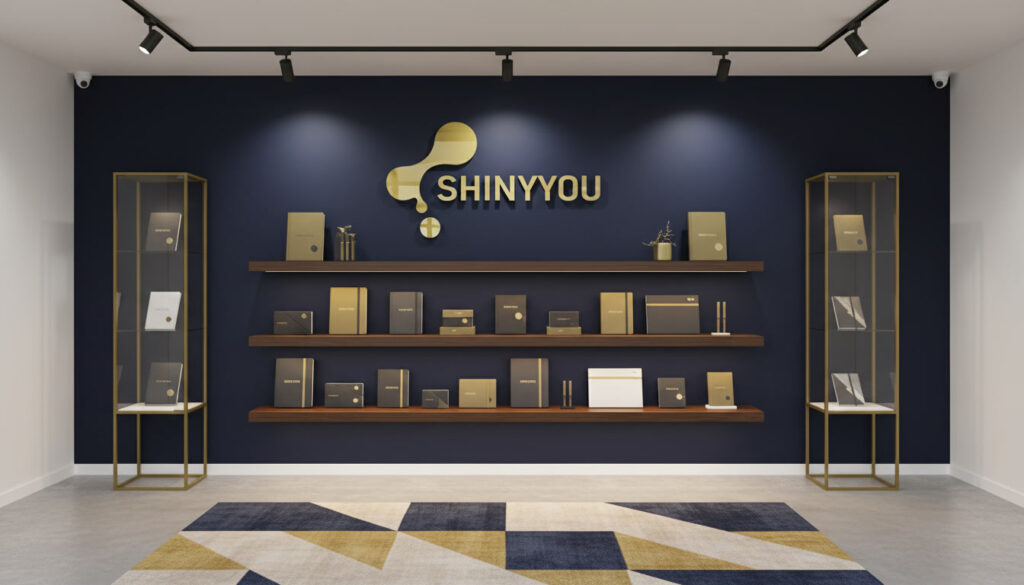
Shiny You’s Ningbo facility, open for buyer visits year-round
Shiny You Stationery is a professional stationery manufacturer based in Ningbo, China, with nearly 20 years of experience supplying retailers, schools, and corporations across 30+ countries. If you’ve read this far, you already know which questions to ask a stationery manufacturer — here is how we answer every one of them covered in this guide:
- Are you a manufacturer or trading company? Direct manufacturer. Our factory spans thousands of square meters in Ningbo — visits welcome, physical or virtual, at any time.
- What certifications do you hold? FSC, BSCI, EUDR, FDA, Walmart FCCA, SCAN, and Disney — all current, all verified, all available as original documents on request.
- What is your MOQ? From 500 units for standard OEM products. We also offer production run entry from just 5 cases for buyers who want to test before scaling.
- What are your OEM capabilities? Full customization — cover design, paper weight, pen barrel colors, packaging, bundling — from first inquiry to delivered product.
- What are your lead times? 7 to 14 days for catalogue products. 35 to 50 days for full OEM. All lead times quoted ex-factory — we will give you the freight timeline to your destination separately and clearly.
- How do you handle quality control? ISO 9001 quality management system. Incoming material inspection, in-process checks, pre-shipment inspection, and third-party inspection accommodation on request.
- Can I see references? Yes — we will connect you directly with existing buyers in your market who have ordered from us across multiple seasons.
- What are your payment terms? 30% deposit, 70% before shipment. T/T standard. Trade Assurance available for first orders.
- What happens if something goes wrong? We have a documented non-conformance process, a defined 7-day claim window after receipt, and a track record of resolving issues professionally and quickly. Ask our references.
Browse our full product range or contact our team at shinyoustationery.com to start the conversation.
The right stationery manufacturer does not just answer these questions — they answer them without hesitation. Ask every one of these questions to ask a stationery manufacturer before you commit, evaluate every answer, and choose the partner whose track record, certifications, and transparency give you complete confidence before you place a single unit.
That’s the whole point of knowing the right questions to ask a stationery manufacturer in the first place.